
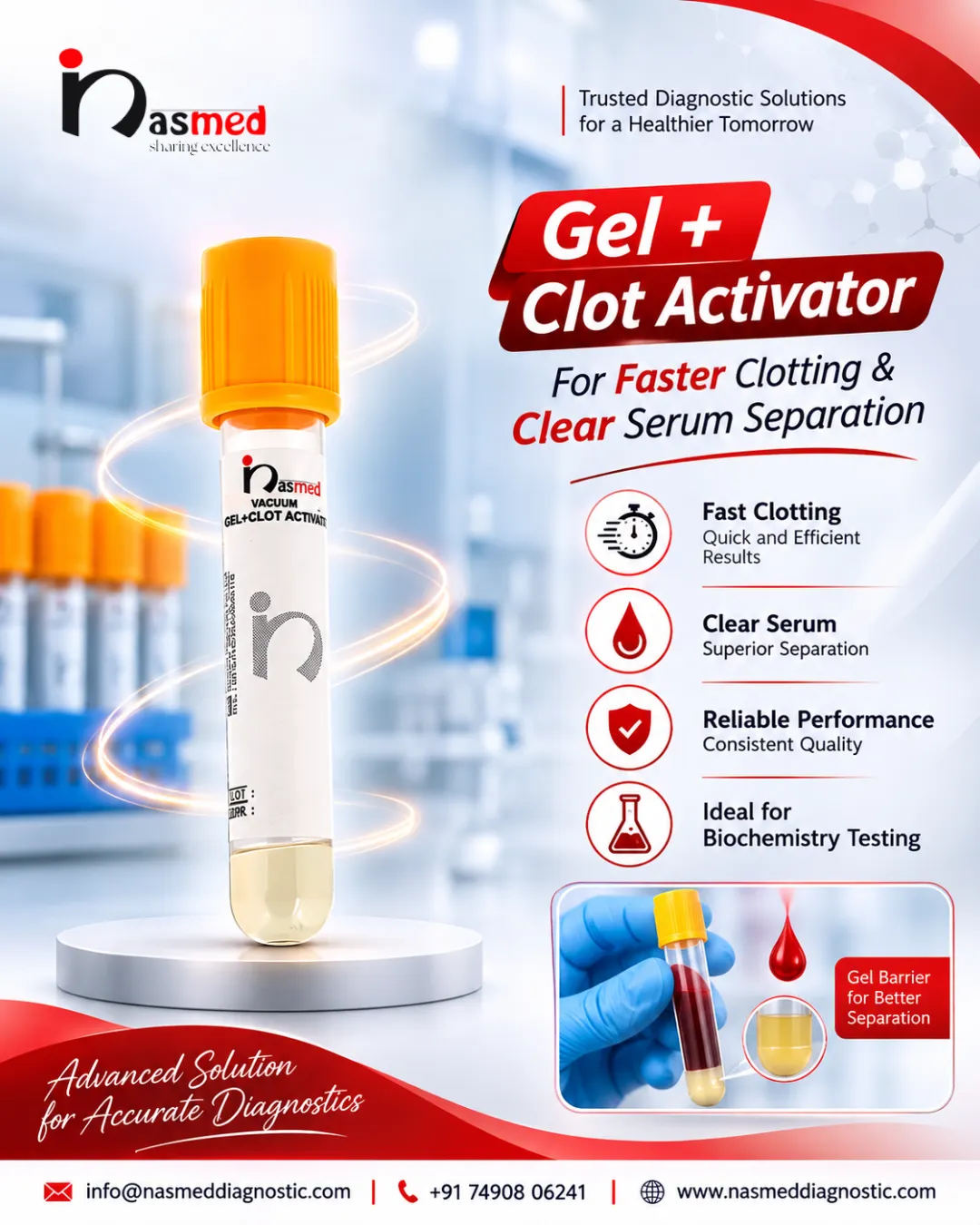
Gel and Clot Activator Tube: Complete Guide to Uses, Working, Tests and Handling Errors
A gel and clot activator tube is the workhorse of routine serum testing. It turns a fresh blood sample into clean, separated serum with very little handling, which is why almost every chemistry and immunology lab depends on it. Yet small errors in mixing, timing or storage can still spoil results.
This guide explains how the tube works, which tests it suits, its limits, and how to handle it correctly, so your team gets reliable serum on the first draw.
Short answer: It is a plastic evacuated tube coated with a clot activator and filled with a separator gel. After clotting and centrifugation, the gel forms a barrier between serum and cells.
What Is a Gel and Clot Activator Tube?
This tube has two working parts. The first is a clot activator, usually silica, coated on the inner wall to speed up clotting. The second is a separator gel at the bottom, made of inert material that forms a physical barrier during centrifugation.
You will hear it called a serum separator tube, an SST tube or simply a gold top tube, after the gold closure used by many manufacturers.
Closure colours can vary, so always read the label.
How It Works, Step by Step
- Collect the blood. The vacuum draws a measured volume straight into the tube.
- Invert gently. BD’s gel tube FAQ recommends 5 inversions for its SST, so blood mixes with the clot activator.
- Let it clot. Keep the tube upright for about 30 minutes before spinning.
- Centrifuge. BD guidance is 10 minutes at 1000 to 1300 g in a swing-bucket centrifuge.
- Use the serum. The separator gel settles between cells below and serum above, so the serum can be sampled directly.
Do not re-centrifuge once the barrier has formed, as this can disturb the gel.
Tests Run on a Gold Top Tube
Serum from this tube supports a wide menu, including:
- Liver function tests such as ALT and AST
- Kidney tests such as creatinine and urea
- Glucose, lipid profile and electrolytes
- Hormone and thyroid assays
- Tumour markers and immunology tests such as PSA
For urgent chemistry, some labs prefer a light green heparin tube because plasma is ready without a clotting wait. Follow the test menu in your collection guide.
Contact UsBenefits of the Separator Gel
- Clean separation: Serum sits above a solid barrier, which lowers the risk of cell contamination.
- Less handling: No need to pipette serum into a second tube before analysis in many workflows.
- Safer transport: The barrier helps keep serum and cells apart on the way to the lab.
- Durable plastic: A plastic serum separator tube is safer than glass for staff.
- Easy identification: A consistent closure colour helps reduce mix-ups on a busy bench.
Gel and Clot Activator Tube vs Other Blood Collection Tubes
| Tube | Sample | Wait before spinning | Typical use |
|---|---|---|---|
| Gel and clot activator | Serum | About 30 minutes | Routine chemistry, immunology |
| Heparin with gel (PST) | Plasma | Can be spun immediately | STAT chemistry |
| EDTA | Whole blood | None | Blood counts, haematology |
| Plain red (no additive) | Serum | Natural clotting | Selected tests, blood bank |
If you are unsure, check what your analyser and test menu specify before choosing.
Limitations You Should Know
- Trace elements: BD states that its SST tube is not validated for trace element testing and recommends a dedicated tube instead.
- Some drugs: BD does not recommend it for tricyclic antidepressant testing. A manufacturer study on therapeutic drug monitoring found that gel can absorb these drugs and advised analysis within 48 hours of medication intake.
- Coagulation tests: According to CLSI, plastic serum tubes with a clot activator can interfere with coagulation testing.
- Freezing: Do not freeze serum on the gel in the original tube. Red cells expand as they freeze and can push through the gel barrier.
Common Handling Mistakes
- Skipping inversions: Poor mixing means incomplete activation and slow or patchy clotting.
- Spinning too early: Serum may form fibrin strands if blood has not fully clotted.
- Wrong order of draw: CLSI places serum tubes after citrate and before heparin and EDTA, which protects results from additive carryover.
- Underfilling: A short draw upsets the blood-to-activator ratio.
- Re-spinning or freezing on gel: Both can break the barrier.
- Poor labelling: Record the patient, time and tube type at the bedside.
Choosing a Quality Tube
When buying a serum separator tube, look for:
- Evenly coated clot activator with consistent performance
- A uniform gel barrier that holds after centrifugation
- Accurate vacuum and draw volume
- Secure, leak-free closures
- Sterile packing and batch traceability
- Compliance with international material guidelines
Cleanroom manufacturing also helps by reducing contamination in a product that must stay chemically clean.
About Nasmed Diagnostics Pvt. Ltd.
Nasmed Diagnostics Pvt. Ltd. (Nasmed Diagnostics) is a Gandhinagar-based manufacturer of diagnostic lab disposables. The company is led by Directors Kush Patel and Suril Shah, with a highly skilled team of technicians and quality experts working in a state-of-the-art ISO 7 cleanroom facility (Class 10,000). It is CDSCO certified and trusted by hospitals, clinics and labs across India.
Its range includes Vacuum, Non-Vacuum, Micro/Paediatric, Cell-Free DNA and Gel Lithium Heparin tubes, plus urine containers and custom diagnostic lab disposables.
Address: Survey No. 282 (Old Block No 213 Paiki), Nandoli, Gandhinagar, Gujarat 382115, India.
Why Choose Nasmed Diagnostics?
- Contamination-free manufacturing in an ISO 7 cleanroom
- CDSCO certified products
- Premium collection tubes for routine and specialised testing
- International material guidelines followed in production
- Affordable pricing without compromising accuracy
- Reliable support and accurate sample handling solutions
- Custom diagnostic lab disposables made to your requirements
Contact: +91 79908 01393 | WhatsApp: +91 74908 06241 | info@nasmeddiagnostic.com
Frequently Asked Questions
What is a gel and clot activator tube used for?
- It collects blood for serum testing, including liver, kidney, lipid, glucose, hormone and immunology tests. The clot activator speeds clotting and the gel separates serum from cells after centrifugation.
What colour is a serum separator tube?
- Many manufacturers use a gold closure, so it is often called a gold top tube. Some use a red-speckled or other closure, so always check the label.
How long should an SST tube clot before centrifuging?
- BD recommends about 30 minutes in an upright position for its SST. Follow your tube maker’s instructions.
How many times should it be inverted?
- Five gentle inversions are recommended by BD for its SST. Avoid shaking, which can cause haemolysis.
Can serum be frozen in the tube on the gel?
- No. Freezing on the gel can break the barrier and mix serum with cells. Transfer serum to a separate tube before freezing.
What is the difference between SST and a plasma separator tube?
- SST gives serum after clotting. A plasma separator tube contains heparin and gel, so plasma can be spun immediately.
Can this tube be used for coagulation tests?
- No. Use a sodium citrate tube for PT and aPTT, as clot activator can interfere.
Who makes quality collection tubes in India?
- Nasmed Diagnostics Pvt. Ltd. in Gandhinagar, Gujarat manufactures CDSCO-certified tubes in an ISO 7 cleanroom. Call +91 79908 01393.
Conclusion
A gel and clot activator tube delivers fast, clean serum when mixed, clotted, and centrifuged correctly. Invert properly, allow full clotting, follow the draw sequence and avoid freezing or re-spinning on the gel. Pair good technique with dependable tubes from a trusted manufacturer. To discuss your requirements, contact Nasmed Diagnostics Pvt. Ltd. on +91 79908 01393, WhatsApp +91 74908 06241 or info@nasmeddiagnostic.com.
Contact Us