

Sodium Fluoride Blood Collection Tubes (Grey Top) for Glucose Testing
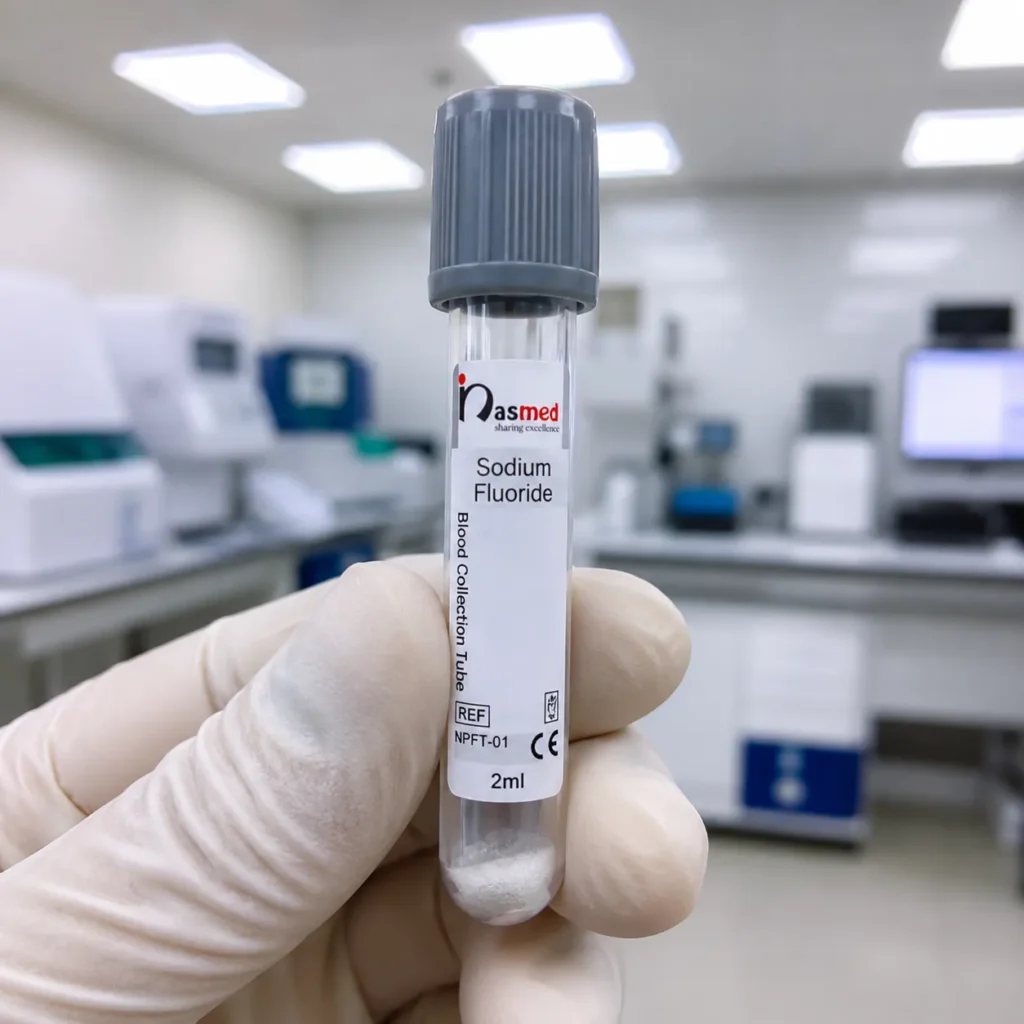
A sodium fluoride (NaF) tube, usually grey-capped, is a blood collection tube used mainly for glucose testing. Sodium fluoride inhibits glycolysis, so blood cells stop consuming glucose after the draw. Most tubes pair it with potassium oxalate, which binds calcium and prevents clotting so plasma can be tested. Nasmed Diagnostics manufactures [vacuum and non-vacuum] sodium fluoride tubes in 13 x 75 mm, 13 X 100 mm, 16 X 100 mm at its facility in Gandhinagar, Gujarat. Below: what the tube is used for, what is inside, how to use it, and how to specify and order it.
What Is a Sodium Fluoride (NaF) Tube?
A sodium fluoride tube is a grey-top blood collection tube that contains sodium fluoride, a glycolysis inhibitor, plus an anticoagulant, normally potassium oxalate. It is made to keep the glucose level in a blood sample close to its value at the time of collection.
Also called: fluoride vial, NaF tube, glucose tube, sugar vial, fluoride container.
What Is a Sodium Fluoride Tube Used For?
It is used when blood must be preserved for tests affected by ongoing cell metabolism.
Glucose testing (fasting, random, OGTT)
Blood cells keep using glucose after collection, so glucose in an unpreserved sample falls over time. This matters most when samples travel long distances or sit in heat before the lab receives them. A fluoride tube slows this loss. [Add your hot-transit point from your case study here, in one or two sentences.]
Lactate and other uses
Fluoride tubes are also used for lactate, which can rise in a sample as cells keep metabolising. Always follow your laboratory’s validated procedure for each test.
Tests a fluoride tube should not be used for
Because the tube adds sodium, fluoride and oxalate, it is not suitable for tests such as electrolytes (sodium/potassium), calcium (oxalate binds calcium) and many enzyme assays. Check your lab’s test directory before choosing the tube.
Sodium Fluoride Tube Colour: Why It Is Grey
Sodium fluoride tubes are identified by a grey cap. Cap and ring shades can vary by brand. For example, Greiner Bio-One’s VACUETTE range uses a white ring on 2 ml tubes and a black ring on 4 and 6 ml tubes. Always read the label for the additive name. For other cap colours, see our guide to the types of blood collection tubes.
Is Sodium Fluoride an Anticoagulant?
Short answer: not by itself. Sodium fluoride mainly stops glycolysis. The anticoagulant in a standard grey-top tube is potassium oxalate, which binds calcium so the blood does not clot.
| Additive | Role in the tube | Note |
|---|---|---|
| Sodium fluoride (NaF) | Inhibits glycolysis, preserves glucose | Acts slowly, see limits below |
| Potassium oxalate | Anticoagulant (binds calcium) | Standard pairing with NaF |
| EDTA or heparin (variants) | Alternative anticoagulant with fluoride | [Include only if Nasmed makes these] |
Sodium fluoride and potassium oxalate: amounts and ratio
Nasmed tubes contain [NaF amount] and [potassium oxalate amount] per mL of blood [fill from your specification]. For reference, the Center for Phlebotomy Education describes typical levels of roughly 2 to 4 mg/mL sodium fluoride and about 2 mg/mL potassium oxalate; actual amounts differ by manufacturer.
How Sodium Fluoride Preserves Glucose, and Its Limits
Sodium fluoride inhibits enzymes in the glycolysis pathway, so cells stop breaking down glucose. It is not instant. A small 2014 study in the Oman Medical Journal (50 paired samples) found the effect starts after roughly 4 hours, so prompt separation of plasma still matters. The same study reported more hemolysis in fluoride tubes (10%) than in SST tubes (4%), and suggested fluoride tubes are most useful when separation is delayed beyond about 2 hours. This is one small single-centre study, so follow your laboratory’s own validated protocol.
How to Use a Sodium Fluoride Tube
- If plasma is needed, centrifuge as per your IFU
- Check the label, expiry date and that the tube is the correct additive tube for the test.
- Fill to the marked volume so the blood-to-additive ratio is correct.
- Mix immediately by gently inverting 8 to 10 times [confirm against Nasmed IFU]. Do not shake vigorously.
- Follow your lab’s order of draw. Fluoride/oxalate tubes are normally drawn last to avoid additive carry-over into other tubes
| Parameter | Nasmed specification |
|---|---|
| Volume(s) | 2.0ml, 3.0ml, 4.0ml, 5.0ml, 6.0ml, 7.0ml, 8.0ml, 9.0ml, 10.0ml. |
| Size (mm) | 13 X 75 mm, 13 X 100 mm, 16 X 100 mm |
| Vacuum / non-vacuum | Depending on the specific variant chosen, this parameter can be Vacuum or Non-Vacuum. |
| Specimen | Plasma |
| Additive and amount | Sodium Fluoride 2mg/ml K2 EDTA- 1.8mg/ml |
| Cap colour | Grey |
| Inversion | Invert the tube 6-8 times gently |
| Invert the tube 6-8 times gently | Centrifuge for 10 minute at 3500-4000RPM |
| Pack Size | 100 Pcs/Box |
Why Choose NASMED Sodium Fluoride Blood Collection Tubes?
- Consistent Quality: Manufactured under controlled conditions with batch-wise quality checks, so lab-to-lab and draw-to-draw results stay reliable.
- Vacuum-Calibrated Fill: Precise vacuum draw ensures the correct blood-to-additive ratio every time, reducing pre-analytical errors.
- Trusted by Diagnostic Professionals: Used by pathology labs and hospitals that depend on accurate glucose reporting for diabetes management and screening programs.
- Regulatory Compliance: Specimen collection tubes in India fall under the Medical Devices Rules, 2017, administered by the Central Drugs Standard Control Organisation (CDSCO), Ministry of Health & Family Welfare, Government of India — you can review the official classification on the CDSCO government portal.
- Full Product Range: Sodium Fluoride tubes are part of a wider blood collection tube portfolio, covering nearly every additive requirement a modern lab needs.
FAQs
Which colour is a sodium fluoride tube?
- Sodium fluoride tubes are usually grey-capped. Ring or cap shades can vary slightly by brand, so always check the label for the additive name and follow your lab’s SOP before drawing blood.
Is sodium fluoride an anticoagulant?
- Not by itself. Sodium fluoride mainly stops glycolysis. The anticoagulant is usually potassium oxalate, which binds calcium so blood does not clot. Some tubes use EDTA or heparin with fluoride instead.
How long is glucose stable in a fluoride tube?
- Fluoride acts slowly. One small study reported its effect starting after about 4 hours, so separate plasma promptly. Stability limits such as up to 24 hours at room temperature are reported by the Center for Phlebotomy Education; follow your lab’s validated limit.
Is a fluoride tube always needed for glucose?
- Not always. A small 2014 Oman Medical Journal study suggested fluoride tubes matter most when plasma separation is delayed beyond about 2 hours. Use one when delay, heat or long transport is expected, and follow your lab protocol.
Should I choose vacuum or non-vacuum sodium fluoride tubes?
- Vacuum tubes draw a preset volume of blood automatically through a holder and needle. Non-vacuum tubes are filled with a syringe or similar method. Choose based on your collection method and your lab’s protocol.
Can a sodium fluoride tube be used for lactate?
- Yes, fluoride tubes are also used for lactate, which can rise in a sample as cells keep metabolising. Always confirm with your laboratory’s validated procedure for the specific test.
How many times should a sodium fluoride tube be inverted?
- Gently invert 8 to 10 times right after collection, as per the Nasmed instructions for use. Do not shake vigorously, because this can cause hemolysis and affect results.