
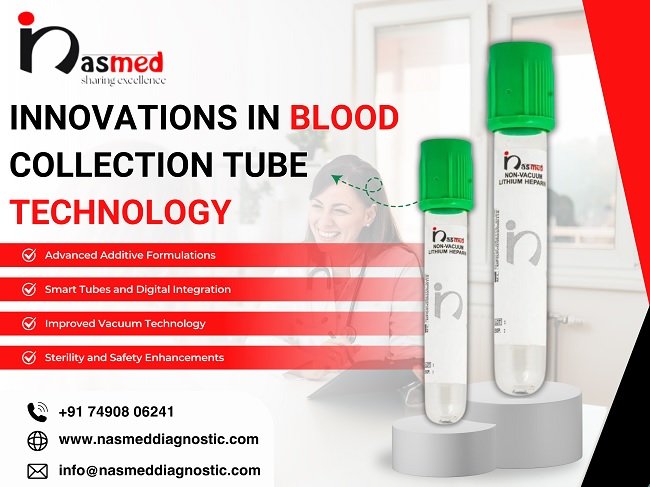
Lithium Heparin Tubes: Uses, Types and How to Choose the Right Supplier
Lithium heparin tubes are blood collection tubes whose inner wall is coated with lithium heparin, an anticoagulant that stops the blood from clotting so the lab can work with plasma instead of serum. Because there is no 30-minute clotting wait, they are the first choice for routine biochemistry, emergency (STAT) testing and high-volume analyzer workflows. In this guide, we explain how lithium heparin blood collection tubes work, which tests they suit, where they should not be used, and what hospitals and labs should check before buying from a supplier in India.
If you only need the product range, you can go straight to our lithium heparin blood collection tube page or browse all blood collection tubes manufactured by Nasmed Diagnostics.
What Are Lithium Heparin Tubes?
A lithium heparin tube is a sterile, usually vacuum-sealed plastic tube with a green closure. Lithium heparin is sprayed and dried onto the inside wall, so it dissolves quickly the moment blood enters the tube. Heparin works by activating antithrombin, a natural protein that blocks the clotting cascade. The blood stays liquid, and after centrifugation the plasma can be read directly on the analyzer.
Two versions are common in laboratories:
- Lithium heparin tube without gel: plasma is removed from the top after centrifugation.
- Lithium heparin tube with separator gel: a gel barrier moves between the plasma and the cells during centrifugation, so the plasma can stay in the same tube and be aspirated directly. This reduces pouring, secondary tubes and transfer errors.
Closure colours can vary slightly by brand (for example green, or mint-green for gel versions), so always check the tube label and the manufacturer’s instructions.
Why Labs Prefer Plasma from Lithium Heparin Tubes
Published laboratory studies describe lithium heparin as the recommended anticoagulant for plasma work because it has the fewest drawbacks compared with other options (Biochemia Medica study on lithium heparin tubes, PMC). In daily practice this gives labs several advantages:
- Faster turnaround: no waiting for the sample to clot before centrifuging.
- Better for urgent samples: ideal for emergency, ICU and OT chemistry where minutes matter.
- Useful for anticoagulated patients: serum from patients on heparin or other anticoagulants may clot slowly and incompletely, while plasma avoids that problem.
- Higher plasma yield: plasma volume is typically larger than serum from the same draw.
- Cleaner workflow with gel tubes: primary-tube sampling on automated analyzers.
Which Tests Use Lithium Heparin Tubes?
Lithium heparin tubes are used mainly for plasma-based clinical chemistry. Typical examples include:
- Electrolytes (sodium, potassium, chloride) and renal function tests such as urea and creatinine
- Liver function tests and enzymes
- Blood glucose and lipid profile (when plasma is separated promptly)
- Cardiac markers and many immunochemistry parameters, subject to the analyzer and kit validation
Always follow the test kit’s package insert, because validated sample types differ between analyzers and reagent brands.
When You Should Not Use Lithium Heparin Tubes
Using the wrong tube is one of the most common pre-analytical errors. Avoid lithium heparin tubes in these cases:
- Blood lithium level monitoring: the additive contains lithium and will falsely raise the result.
- Complete blood count (CBC) and blood smears: use an EDTA tube instead.
- Coagulation tests (PT, aPTT): use a sodium citrate tube, because heparin directly affects these results.
- Many PCR and molecular tests: heparin can inhibit PCR enzymes, so EDTA is usually preferred. For cell-free DNA work, use dedicated cell-free DNA tubes.
For a complete overview of additives and colour codes, read our guide on the types of blood collection tubes.
Lithium Heparin vs Other Blood Collection Tubes
| Tube type | Additive | Sample obtained | Typical use |
|---|---|---|---|
| Lithium heparin (green) | Lithium heparin | Plasma | Routine and STAT biochemistry |
| Sodium heparin (green) | Sodium heparin | Plasma | Tests where lithium or sodium contamination is not an issue, cytogenetics in some labs |
| Serum / clot activator | Clot activator, with or without gel | Serum | Routine chemistry, serology, hormones |
| EDTA (lavender) | K2 or K3 EDTA | Whole blood / plasma | Haematology (CBC), HbA1c |
| Sodium citrate (light blue) | Buffered sodium citrate | Plasma | Coagulation tests |
| Sodium fluoride (grey) | Sodium fluoride and anticoagulant | Plasma | Glucose preservation |
Best Practices for Collecting and Handling Lithium Heparin Tubes
Even the best tube cannot fix poor handling. Share these steps with your phlebotomy team:
- Check the label and expiry date before every draw, and confirm the tube is the right additive for the test.
- Fill the tube to the marked draw volume. Underfilling changes the blood-to-anticoagulant ratio.
- Follow the correct order of draw as per your laboratory protocol and CLSI guidance to avoid additive carry-over.
- Mix gently by inversion immediately after collection, as per the manufacturer’s instructions. Do not shake, as this can cause haemolysis.
- Centrifuge on time at the speed and duration recommended on the pack insert, and separate or analyze plasma promptly.
- Store and transport as per your SOP, away from heat and direct sunlight.
How to Choose a Reliable Lithium Heparin Tubes Supplier in India
Price per tube matters, but sample rejection, repeat draws and analyzer downtime cost far more. Use this checklist when comparing blood collection tubes manufacturers and diagnostic tubes suppliers:
- Regulatory status: ask for the CDSCO licence and batch-wise documents. You can read more about the regulator on the CDSCO official website.
- Manufacturing environment: a controlled clean room (such as ISO 7, equal to Class 10,000) lowers particle and contamination risk.
- Additive uniformity: even spray-drying of heparin gives faster mixing and fewer micro-clots.
- Vacuum retention and draw volume accuracy: request test records or a trial batch.
- Analyzer compatibility: confirm tube sizes (for example 13×75 mm and 13×100 mm) fit your racks and automation.
- Customisation and support: custom draw volumes, labelling, and reliable delivery timelines.
Lithium Heparin Tubes from Nasmed Diagnostics
Nasmed Diagnostics Pvt. Ltd. is a CDSCO certified manufacturer of blood collection tubes, led by Directors Kush Patel and Suril Shah. Our products are made in a controlled ISO 7 clean room (Class 10,000) at Survey No. 282 (Old Block No. 213 Paiki), Nandoli, Gandhinagar, Gujarat 382115. Our lithium heparin tubes are designed for consistent additive coating, dependable vacuum draw and smooth plasma separation on automated analyzers.
Besides lithium heparin tubes, we manufacture a wider range of lab disposables, including:
- Vacuum and non-vacuum blood collection tubes
- Micro and pediatric tubes for small-volume draws
- Cell-free DNA tubes
- Urine containers
We supply hospitals, pathology chains, clinics and distributors across India, including Mumbai, Delhi, Bengaluru, Hyderabad, Chennai, Kolkata, Pune, Ahmedabad and Surat. You can also learn more about our vacuum blood collection tubes manufacturing in Gandhinagar or read about Nasmed Diagnostics.
Need samples, bulk pricing or a custom specification? Contact our team for a quote on lithium heparin tubes or call +91 79908 01393.
Frequently Asked Questions
Q. What are lithium heparin tubes used for?
They are used to collect blood for plasma-based tests, mainly routine and emergency clinical biochemistry. The lithium heparin prevents clotting, so the sample can be centrifuged straight away.
Q. What colour is a lithium heparin tube?
Lithium heparin tubes normally have a green closure. Gel-separator versions may use a mint-green or light-green closure depending on the brand, so always read the label.
Q. What is the difference between lithium heparin and sodium heparin tubes?
Both give plasma, but they differ in the salt used. Lithium heparin is preferred for most routine chemistry. Sodium heparin is avoided when sodium is being measured, and lithium heparin is avoided when lithium is being measured.
Q. Can I use a lithium heparin tube for a CBC?
No. CBC and blood smear tests need an EDTA tube. Heparin can affect cell morphology and is not recommended for haematology.
Q. Why use a lithium heparin tube with gel?
The gel forms a barrier between plasma and cells after centrifugation. This lets the lab sample plasma directly from the primary tube and reduces handling errors.
Q. Are Nasmed lithium heparin tubes CDSCO certified?
Yes. Nasmed Diagnostics is a CDSCO certified manufacturer, and tubes are produced in an ISO 7 (Class 10,000) clean room. Batch-wise documents are available on request.
Q. How can I get a quote or sample?
Call +91 79908 01393, message us on WhatsApp at +91 74908 06241, or email info@nasmeddiagnostic.com. You can also use our contact page.