
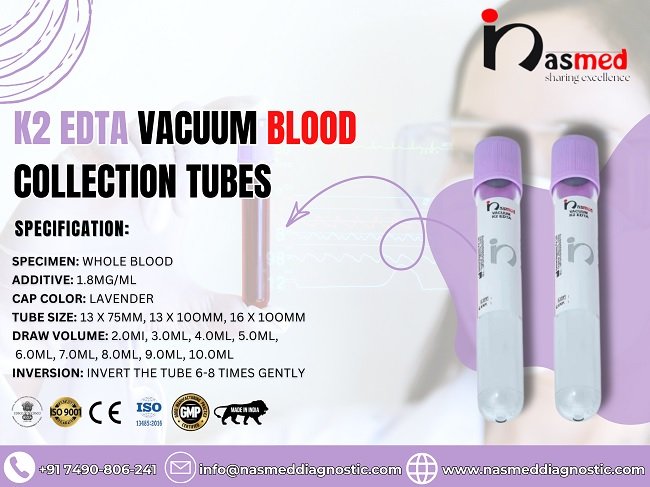
K2 EDTA Vacuum Blood Collection Tubes in India
An EDTA tube is a blood collection tube that contains EDTA, an anticoagulant that binds calcium so the sample does not clot.
It is the standard tube for complete blood counts and other haematology tests and is recognised by its lavender or purple cap.
This guide explains what K2 EDTA means, how it differs from K3 EDTA, which tests use it and how to handle the sample.
It also gives the specifications of Nasmed Diagnostics’ K2 EDTA vacuum blood collection tubes, manufactured in Gujarat, India, and how to request a quote.
What Is an EDTA Tube?
An EDTA tube holds whole blood for tests that need cells to stay intact and unclotted. EDTA works by chelating (binding) calcium ions, which blocks the clotting cascade. This keeps red cells, white cells and platelets in their natural state so analysers and microscopists can count and examine them.
The tube is sometimes called an EDTA vial, EDTA bulb, EDTA container or lavender-top tube. These are common lab names for the same family of tubes.
EDTA Full Form and Meaning
EDTA = ethylenediaminetetraacetic acid. In blood collection it is used as a potassium salt: K2 EDTA (dipotassium) or K3 EDTA (tripotassium).
Which Tests Use an EDTA Tube?
| Test or use | Notes |
|---|---|
| Complete blood count (CBC) and platelet count | The main use of the lavender-cap tube. |
| Peripheral blood smear and reticulocyte count | Preserves cell morphology. |
| HbA1c | Whole-blood test run on EDTA samples. |
| Blood grouping and cross-matching | Blood bank use; some labs use a pink-cap EDTA tube. |
| ESR | Some methods use EDTA blood. Follow your lab’s method. |
| Molecular tests (DNA / RNA, viral load) | K2 EDTA whole blood or plasma, depending on the assay. |
Tests That Should Not Use an EDTA Tube
- PT/INR and aPTT: need citrate tubes because EDTA removes the calcium these tests depend on.
- Calcium and magnesium: EDTA binds both.
- Potassium: K2 and K3 EDTA contain potassium and can falsely raise the result.
- Most routine biochemistry: use serum or the tube your analyser specifies.
K2 EDTA vs K3 EDTA: Differences at a Glance
| Feature | K2 EDTA | K3 EDTA |
|---|---|---|
| Chemical form | Dipotassium EDTA | Tripotassium EDTA |
| Form in the tube | Dry (spray-dried) | Usually liquid |
| Effect on sample volume | No dilution | Dilutes the sample by about 1 to 2% (BD) |
| Typical use | Haematology, molecular testing | Haematology where the lab specifies K3 |
| Cap colour | Lavender / purple for both | |
Many laboratories prefer K2 EDTA for haematology because it does not dilute the sample. Use the type your analyser manufacturer and laboratory protocol require.
EDTA Tube Colour Codes
| Cap colour | Typical use |
|---|---|
| Lavender / purple | K2 or K3 EDTA: CBC and haematology |
| Pink | EDTA for blood grouping and cross-matching (blood bank) |
| Royal blue | Trace elements and heavy metals |
| Tan | Blood lead |
| White with gel | EDTA plasma separation for molecular tests |
Cap colours can vary between manufacturers. Always read the tube label.
Nasmed K2 EDTA Vacuum Blood Collection Tubes: Specifications
| Parameter | Specification |
|---|---|
| Specimen | Whole blood |
| Additive | K2 EDTA, 1.8 mg per mL of blood |
| Cap colour | Lavender |
| Tube size | 13 x 75 mm, 13 x 100 mm, 16 x 100 mm |
| Draw volume | 2 mL, 3 mL, 4 mL, 5 mL, 6 mL, 7 mL, 8 mL, 9 mL, 10 mL |
| System | Vacuum |
| Mixing after collection | Invert gently, as directed in the instructions for use |
Features
- Accurate draw volume: a controlled vacuum draws the intended blood volume, reducing under-fill errors.
- Consistent anticoagulant: a uniform K2 EDTA coating supports reliable anticoagulation.
- Colour-coded stopper: lavender cap for quick identification.
- Sterile: supplied sterile to reduce contamination risk.
Applications
Haematology testing, molecular diagnostics, clinical research, blood typing and other specialised testing that needs unclotted whole blood.
Sizes, Pack Quantities and How to Order
Tell us the tube size, draw volume and monthly quantity you need and we will send pack sizes and a quote. Call +91 74908 06241 or email info@nasmeddiagnostic.com (Mon to Sat, 9:00 AM to 6:00 PM). See the full product page: K2 EDTA vacuum blood collection tube specifications and enquiry.
Vacuum vs Non-Vacuum EDTA Tubes
Vacuum tubes are pre-evacuated, so the vacuum draws blood in when the tube is connected to a holder and needle. Non-vacuum tubes are filled by syringe or capillary flow. Vacuum systems give a controlled draw volume. Browse our vacuum blood collection tubes, including K3 EDTA and other additives.
How to Collect and Handle EDTA Samples
- Label the tube at the bedside with the patient’s details.
- Follow the order of draw your laboratory uses (EDTA tubes come after citrate, serum and heparin tubes in the CLSI order).
- Fill to the stated draw volume. Under-filling gives too much EDTA per mL of blood.
- Mix immediately by gentle inversion as per the tube’s instructions for use. Do not shake.
- Store at room temperature as directed and test within your laboratory’s stability window.
Common errors: clotted samples, haemolysis, under-filling, wrong tube type and delayed mixing.
Why Labs Buy from a Manufacturer
Nasmed Diagnostics Pvt. Ltd. is a CDSCO-certified manufacturer of blood collection tubes, with an ISO 7 clean room facility in Nandoli, Gandhinagar, Gujarat. Buying direct from a manufacturer gives hospitals, diagnostic laboratories and distributors a direct route to technical details and bulk supply across India.
FAQs
What is the full form of EDTA and what does K2 mean?
- EDTA stands for ethylenediaminetetraacetic acid. In a K2 EDTA tube the anticoagulant is the dipotassium salt of EDTA, usually sprayed or dried onto the tube wall. K3 EDTA is the tripotassium salt, which is usually supplied as a liquid.
Which tests are done in an EDTA tube and what is the cap colour?
- EDTA tubes have a lavender or purple cap. They are used mainly for haematology tests such as complete blood count (CBC), platelet count and peripheral smear, and also for HbA1c, blood grouping and cross-matching, and many molecular tests. ESR is run on EDTA blood by some methods, so follow your laboratory’s method.
What is the difference between K2 EDTA and K3 EDTA?
- Both stop clotting by binding calcium. K2 EDTA is dry and does not dilute the sample. K3 EDTA is liquid and, according to BD, dilutes the sample by about 1 to 2 percent. K2 EDTA is generally preferred for haematology and molecular work, but always follow your analyser and laboratory protocol.
Is an EDTA vial the same as an EDTA bulb or EDTA tube?
- In everyday lab language, EDTA vial, EDTA bulb, EDTA container and EDTA sample tube usually refer to the same family of lavender-cap blood collection tubes. The correct product name is EDTA blood collection tube, specified by anticoagulant (K2 or K3), size and vacuum or non-vacuum system.
How many times should you invert an EDTA tube?
- Mix the tube immediately after collection by gently inverting it. BD recommends 8 to 10 inversions for its EDTA tubes. Follow the instructions for use supplied with your tubes, and do not shake the tube vigorously, which can damage cells.
Which tests should not be run on an EDTA sample?
- EDTA blood is not suitable for coagulation tests such as PT/INR and aPTT, for calcium or magnesium measurement, for potassium, or for most routine biochemistry. EDTA removes calcium and magnesium and, in K2 and K3 tubes, adds potassium.
What is the additive concentration in K2 EDTA tubes?
- The commonly used concentration is about 1.8 mg of EDTA per mL of blood, the figure BD states for its EDTA tubes. Nasmed’s K2 EDTA specification lists 1.8 mg/mL. Check the label and datasheet of the specific tube you order.
What sizes of K2 EDTA vacuum tubes does Nasmed supply?
- Nasmed’s K2 EDTA vacuum tubes are listed in tube sizes 13 x 75 mm, 13 x 100 mm and 16 x 100 mm, with draw volumes from 2 mL up to 10 mL. Contact us for the exact size, pack quantity and price for your requirement.
How should K2 EDTA tubes be stored?
- Store tubes at room temperature in a clean, dry place away from direct sunlight and heat, and use them before the expiry date printed on the pack.
What are the signs of improper collection in an EDTA tube?
- Clots in the sample, haemolysis (ruptured red cells), underfilled tubes and wrong mixing can all give inaccurate results. Fill the tube to the stated draw volume and mix gently straight after collection.