
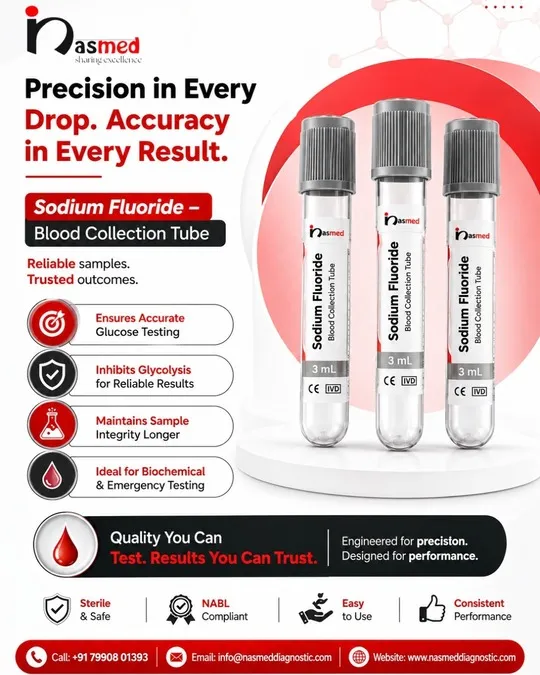
Sodium Fluoride Tube (Grey Top): Uses, Colour, Additives and Tests
A sodium fluoride tube is a grey-top blood collection tube used mainly for glucose tests: fasting blood sugar (FBS), post-prandial (PP) and the oral glucose tolerance test (OGTT).
It holds two additives with separate jobs.
Sodium fluoride slows glycolysis, so the blood cells stop using up glucose. An anticoagulant, usually potassium oxalate or Na2EDTA, stops the blood from clotting.
Fluoride is not a reliable anticoagulant on its own, and it does not work instantly.
Published work reports that glucose can still fall during roughly the first 30 to 90 minutes after collection.
That is why quick transport and correct handling still matter.
This guide explains the tube colour, what the tube is used for, which tests it should not be used for, the order of draw, how long glucose stays stable, and when a serum gel tube can do the job instead.
Need the answer fast? Start with this quick summary of the grey-top sodium fluoride tube.
Sodium fluoride tube at a glance
Short on time? This quick-reference table answers the most common questions about the grey-top sodium fluoride tube. Details and sources follow in the sections below.
| Question | Short answer |
|---|---|
| What colour is it? | Grey stopper (colours can vary slightly by manufacturer) |
| What is inside? | Sodium fluoride plus an anticoagulant: potassium oxalate in most tubes, Na2EDTA or heparin in some |
| What is it used for? | Glucose tests (FBS, PP, OGTT). Some labs also use it for lactate and blood alcohol |
| What does the fluoride do? | Blocks the enzyme enolase, which slows glycolysis |
| Where is it in the order of draw? | Last, after citrate, serum, heparin and EDTA tubes |
| How many inversions? | 8 to 10 gentle inversions straight after collection, or as the manufacturer’s instructions say |
| What should not go in it? | Calcium tests, routine enzyme chemistry, and CBC or haematology tests |
What colour is a sodium fluoride tube?
A sodium fluoride tube has a grey stopper. Phlebotomists use this colour code to pick the glucose tube quickly, even during a busy collection round.
You may also hear it called a fluoride vial, fluoride bulb, NaF tube or “sugar tube”. These names usually mean the same grey-top glucose tube.
Grey top and brand differences
Stopper colours and additive combinations are not identical across every manufacturer. Always check the label and the instructions for use (IFU) of the tube you are using, and follow your laboratory’s validated protocol.
The featured image at the top of this post shows a grey-top sodium fluoride blood collection tube.
What is a fluoride tube used for? Which tests need it
The grey-top tube is chosen mainly for glucose testing, where the result must reflect the patient’s glucose at the time of collection.
Fasting, post-prandial and OGTT glucose
- Fasting blood sugar (FBS): diagnosing and monitoring diabetes.
- Post-prandial (PP) glucose: glucose measured after a meal.
- Oral glucose tolerance test (OGTT): including screening for gestational diabetes.
Glucose is one of the most requested tests in any laboratory, and a falsely low value can delay a diagnosis or force a repeat sample. Using the right tube is the easiest way to avoid that.
Lactate and blood alcohol
Some laboratories also use the grey tube for lactate and for blood alcohol testing, especially when testing may be delayed or the result must be defensible. Fluoride also limits microbial growth in the sample, which can help in these cases. Check your laboratory’s protocol before choosing the tube for these tests.
Tests that should not use a grey tube
- Calcium: oxalate binds calcium, so results will be wrong.
- Routine enzyme-based chemistry: fluoride can interfere with some enzyme assays. Use a serum or heparin tube unless your lab has validated the grey tube for the test.
- CBC and haematology: use a lavender-top EDTA tube. Oxalate can distort cells.
If a grey tube is filled before other tubes, its additives can carry over and spoil other results. That is why it is drawn last.
Contact UsWhy a fluoride tube is used for glucose tests
Blood cells stay alive after the blood is drawn, and they keep using glucose. Without a preservative, the glucose level in the tube keeps falling.
How fast glucose falls without a preservative
Commonly cited references put the fall at about 5 to 7 percent per hour at room temperature, and some quote up to 10 percent. The exact rate depends on the sample, the temperature and the number of cells. A few hours is enough to hide a high fasting value or distort an OGTT curve.
What fluoride blocks, and the 30 to 90 minute delay
Sodium fluoride inhibits enolase, an enzyme in the glycolysis pathway. This slows the cells’ glucose use. It does not stop it at once: a 2008 paper in Clinical Chemistry points out that fluoride does not prevent loss of plasma glucose during the first 30 to 90 minutes. Another educational source puts full inhibition at around 2 to 4 hours.
What this means for collection and transport
- Mix the tube immediately so the additive reaches all the blood.
- Send the sample to the laboratory promptly.
- If your lab SOP requires it, separate the plasma within the validated time.
With correct handling, glucose in a properly filled and mixed tube is commonly reported as stable for about 24 hours at room temperature. Validated limits differ by tube and laboratory, so always follow your lab’s protocol and the tube’s IFU.
Is sodium fluoride an anticoagulant?
No, not reliably. Fluoride is a weak anticoagulant on its own, so manufacturers pair it with a second additive that prevents clotting. The fluoride does the glucose preservation; the partner additive keeps the blood liquid.
Fluoride with oxalate, EDTA or heparin
| Combination | Role of each additive | Notes |
|---|---|---|
| Sodium fluoride + potassium oxalate | Fluoride slows glycolysis; oxalate binds calcium to stop clotting | The most common grey-top tube. Used for glucose, and in some labs lactate and alcohol |
| Sodium fluoride + Na2EDTA (K3EDTA in some brands) | Fluoride slows glycolysis; EDTA binds calcium | Used in some tubes for glucose-focused testing |
| Sodium fluoride + sodium heparin | Fluoride slows glycolysis; heparin acts as the anticoagulant | Offered by some manufacturers. Check the IFU |
A commonly quoted reference concentration is about 2 mg of fluoride and 3 mg of oxalate per mL of blood, but the supplier’s specification always takes priority.
Grey top vs other blood collection tubes
Using the wrong tube is one of the most common pre-analytical mistakes. This table shows where the grey tube sits among the common tubes, in CLSI order of draw.
| Order | Tube colour | Additive | Typical use |
|---|---|---|---|
| 1 | Light blue | Sodium citrate | Coagulation tests (PT, INR, APTT) and ESR |
| 2 | Red / gold | Clot activator, with or without gel | Serum chemistry |
| 3 | Green | Heparin | Plasma chemistry |
| 4 | Lavender | EDTA | CBC and haematology |
| 5 | Grey | Sodium fluoride + oxalate / EDTA | Glucose, lactate, alcohol |
Blood culture bottles, if drawn, come before all of these.
Nasmed light-blue sodium citrate tube, for reference
For comparison, here are the specifications of Nasmed’s light-blue tube, which uses 3.8% (0.129 mol/L) tri-sodium citrate with a 9:1 blood-to-additive ratio. It is a sterile, single-use, non-pyrogenic vacuum tube in medical-grade glass or shatter-resistant PET, available in 1.8 mL, 2 mL, 2.7 mL and 3 mL (custom sizes available). See the sodium citrate blood collection tube and the lithium heparin blood collection tube for details.
Sodium fluoride tube vs serum gel tube: when is fluoride really needed?
Fluoride tubes were designed for situations where the sample waits before it is separated from the cells. If a sample is centrifuged quickly and the serum is separated by a gel barrier, glucose can stay stable without fluoride. Recent studies, including some from India, look at exactly this question.
| Study | What it found |
|---|---|
| JIPMER, Pondicherry (Cureus, 2024; 50 participants) | Median glucose at 1 hour was 97 mg/dL in both tubes. At 6 hours it was 83.5 mg/dL in serum tubes and 92.0 mg/dL in sodium fluoride tubes. From 1 to 6 hours the median fell 14 mg/dL in serum and 5 mg/dL in fluoride tubes |
| Meenakshi Labs, Madurai (Int J Res Med Sci, 2024) | Serum, EDTA, fluoride and heparin tubes gave similar glucose results over 24 hours when samples were centrifuged immediately and stored at 2 to 4 C |
| Winter et al. (Clin Chem Lab Med, 2018; 61 volunteers) | Serum separated rapidly from cells by a gel barrier stayed stable for an extended time. Stability differed between glycolysis-inhibitor tubes of different makes |
What this means in practice
- Fluoride tubes matter most when separation is delayed. Examples are collection camps, home collection and courier transport to a central lab.
- Gel serum tubes can work where centrifugation is quick and guaranteed, if the laboratory has validated this.
- The right choice is a lab decision, based on transport time, temperature, the test and the lab’s validated limits. A 2019 letter on the topic also notes that fluoride tubes were most useful when serum separation was delayed by 4 hours or more.
The JIPMER authors note that they could not compare fluoride tubes with citrate-buffered glucose tubes, because those tubes were not available in India.
How to collect a grey-top tube: order of draw and checklist
Good technique protects the result as much as the additive does.
Where the grey tube goes
The grey tube is drawn last, after citrate, serum, heparin and EDTA tubes, as set out in the CLSI order of draw. This stops fluoride and oxalate from carrying over into other tubes.
Step-by-step checklist
- Check the label and the expiry date. Expired tubes can lose vacuum and the additive can degrade.
- Draw the grey tube last.
- Fill to the marked volume. An under-filled tube changes the additive-to-blood ratio and can give invalid values.
- Invert gently 8 to 10 times straight after collection, or as the manufacturer’s IFU says. Do not shake the tube, because that can cause haemolysis.
- Label at the bedside and send to the laboratory promptly.
- Store unused tubes as the manufacturer instructs, away from heat and direct sunlight.
Three mistakes that cause recollection
- Drawing the grey tube before other tubes. Carry-over can cause falsely low calcium and problems with other tests.
- Skipping the inversions. Poor mixing is a leading cause of clotted grey-top samples and unprotected glucose.
- Delaying transport without a plan. Fluoride needs time to act, so long waits, heat or delayed separation can still affect the result.
Fluoride vacutainer, vial and bulb: names and formats
People search for this tube under many names, and they are easy to mix up.
- Vacutainer is a brand name used by BD. In everyday lab talk, “fluoride vacutainer” usually means any evacuated grey-top fluoride tube, whatever the maker.
- Fluoride vial, fluoride bulb and NaF tube are common local names for the same type of tube.
- Vacuum and non-vacuum tubes: vacuum (evacuated) tubes draw a set volume of blood automatically, while non-vacuum tubes are filled by syringe or manual collection. Nasmed makes both vacuum and non-vacuum blood collection tubes. Check the sodium fluoride blood collection tube for the exact format and sizes available.
Choosing a sodium fluoride tube supplier in India: a checklist
The tube is part of the test, so quality matters as much as technique. When you compare suppliers, ask about:
- Additive uniformity and fill accuracy: the powder must be evenly distributed and correctly dosed in every tube.
- Vacuum retention: the tube must draw the labelled volume until its expiry date.
- Tube material: glass or PET, and how well it resists breakage.
- Sterility and manufacturing environment: clean-room production and single-use sterile tubes.
- Batch traceability and expiry labelling: so any issue can be traced.
- Approvals: CDSCO and ISO approvals for the manufacturer.
- Samples and support: the chance to test tubes in your own workflow before you order in bulk.
Why choose Nasmed Diagnostics?
Nasmed Diagnostics Pvt. Ltd. is a Gujarat-based manufacturer of diagnostic consumables, led by Directors Kush Patel and Suril Shah. Our products are CDSCO and ISO approved, and they are made in an ISO 7 (Class 10,000) clean room facility that supports contamination-free production.
- A wide range of blood collection tubes: vacuum, non-vacuum, micro/paediatric, cell-free DNA and gel lithium heparin tubes, plus urine containers.
- Custom diagnostic lab disposables built around your requirements.
- Reliable support and accurate sample handling solutions.
- Trusted by hospitals, clinics and laboratories across India.
Want to test our sodium fluoride tubes? Contact us to request details or a sample.
Address: Survey No 282 (Old Block No 213 Paiki), Nandoli, Gandhinagar, Gujarat 382115, India Phone: +91 79908 01393 | WhatsApp: +91 74908 06241 Email: info@nasmeddiagnostic.com
Frequently asked questions
What colour tube is used for sodium fluoride?
The grey-top tube. It holds sodium fluoride with an anticoagulant, normally potassium oxalate or Na2EDTA. Check the manufacturer’s label, because some brands differ.
What is the purpose of fluoride in a blood tube?
Fluoride is an antiglycolytic agent. It slows the breakdown of glucose by blood cells, so the measured glucose stays close to the level at collection.
Is sodium fluoride an anticoagulant?
Not on its own. Tubes combine fluoride with potassium oxalate, EDTA or heparin, which prevent clotting.
Which tests need a grey-top tube?
Fasting, post-prandial and random glucose, and the OGTT. Some labs also use it for lactate and blood alcohol.
How long does glucose stay stable in a fluoride tube?
About 24 hours at room temperature is commonly reported, but validated limits vary by tube and laboratory. Always follow your lab’s protocol.
Does fluoride work immediately?
No. Research reports that glucose can still fall in the first 30 to 90 minutes, so prompt transport and mixing still matter.
Where does the grey tube go in the order of draw?
Last, after citrate, serum, heparin and EDTA tubes, to prevent additive carry-over.
Can I use a grey tube for calcium or routine chemistry?
No. Oxalate binds calcium, and fluoride can interfere with some enzyme assays.
What happens if the tube is under-filled?
The additive-to-blood ratio changes, which can give invalid glucose values. Fill to the marked volume.
Why does the lab sometimes ask for a serum tube instead?
If samples are centrifuged quickly and the serum is separated by a gel barrier, glucose can stay stable without fluoride. The choice depends on the lab’s validated workflow.
Contact Us