
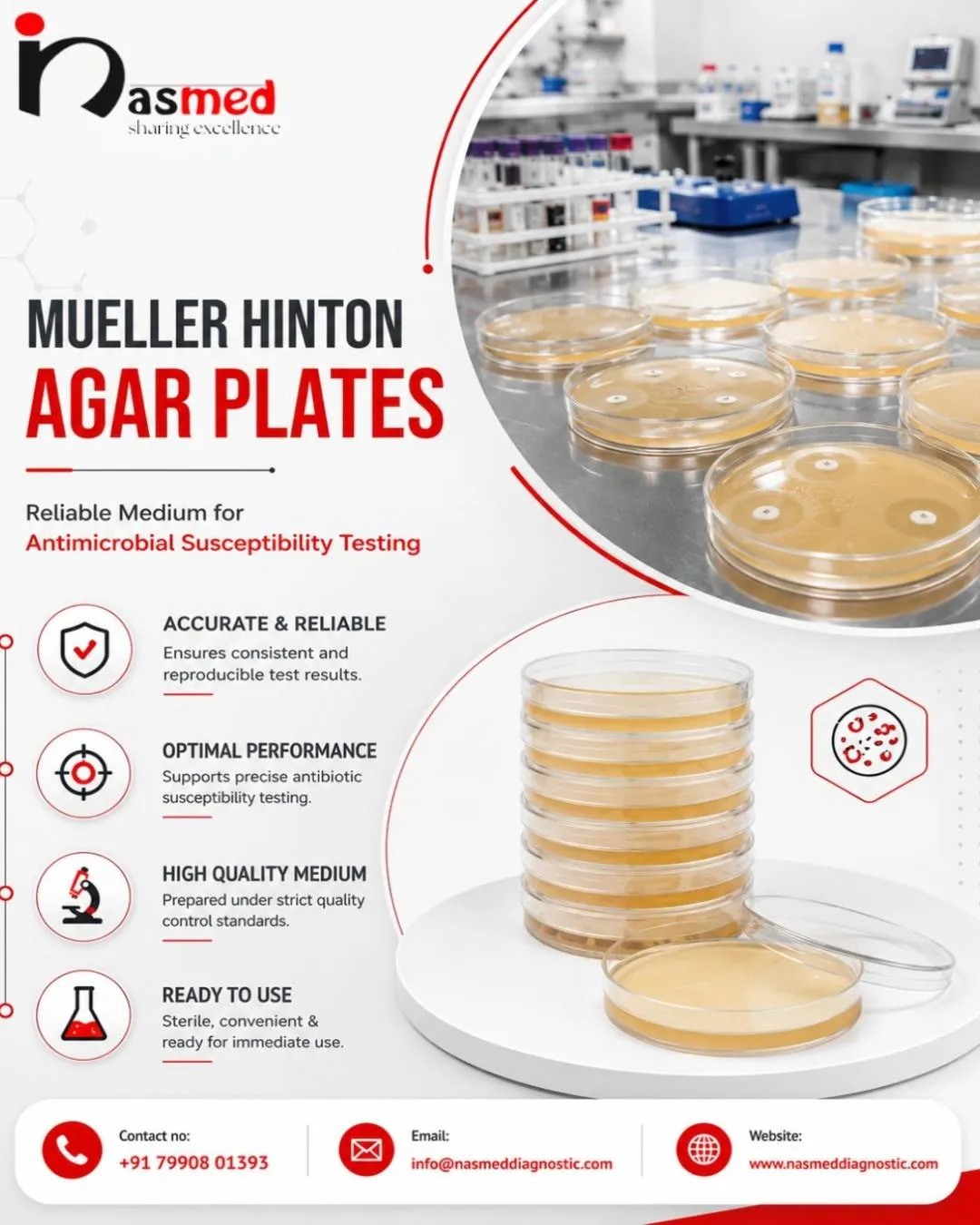
Mueller Hinton Agar Plates: Preparation, Uses & Applications
Mueller Hinton Agar Plates are the world’s standard medium for antibiotic susceptibility testing. A lab places antibiotic discs on these plates and measures how well each drug stops bacterial growth.
A small error in plate quality can change that result, and the treatment that follows. This guide covers composition, preparation, the Kirby-Bauer method, result reading, uses, and troubleshooting.
Key takeaways
- MHA is the medium recommended by CLSI and EUCAST for disc diffusion testing.
- Use 4 mm agar depth, pH 7.2–7.4, and a 0.5 McFarland inoculum.
- Incubate at 35 ± 2°C for 16–18 hours.
- Compare each zone of inhibition with current breakpoints.
What Are Mueller Hinton Agar Plates?
Mueller Hinton Agar (MHA) is a non-selective, non-differential culture medium.
John Mueller and Jane Hinton developed it in 1941 to grow Neisseria species. Today, labs use it mainly for antibiotic susceptibility testing of rapidly growing bacteria.
Three qualities explain its global use:
- Batch-to-batch consistency: Results stay reproducible across labs.
- Low inhibitor levels: Sulfonamide, trimethoprim, and tetracycline inhibitors stay minimal.
- Broad growth support: Most non-fastidious pathogens grow well.
Mueller Hinton Agar Composition
The Mueller Hinton agar composition is simple, and each ingredient has a clear job.
| Ingredient | Typical Quantity (g/L) | Function |
|---|---|---|
| Beef extract | 2.0 | Supplies nitrogen, vitamins, and minerals |
| Acid hydrolysate of casein | 17.5 | Provides amino acids and carbon |
| Starch | 1.5 | Absorbs toxic substances and releases dextrose |
| Agar | 17.0 | Solidifies the medium |
| Final pH (25°C) | 7.3 ± 0.1 | Keeps antibiotic activity stable |
The medium also contains very little thymine and thymidine. These compounds would otherwise interfere with sulfonamide and trimethoprim results.
How to Prepare Mueller Hinton Agar Plates
You can buy ready-to-use plates or make them from dehydrated powder. Follow these steps:
- Weigh the powder. Dissolve about 38 g of dehydrated MHA in 1 litre of purified water, or follow the label.
- Heat to dissolve. Boil gently until the agar dissolves completely.
- Sterilize. Autoclave at 121°C for 15 minutes.
- Cool. Let the medium reach 45–50°C before pouring.
- Pour. Add about 25 mL to each 90 mm plate for a 4 mm depth.
- Set and check. Let the agar solidify on a level surface. Confirm the pH is 7.2–7.4.
- Store. Keep plates at 2–8°C, sealed and away from moisture.
Depth matters. Thin plates create oversized zones, and thick plates create undersized zones.
Contact UsKirby-Bauer Method: Step by Step
The Kirby-Bauer method is the most common disc diffusion technique. It shows how far an antibiotic spreads and stops growth.
- Prepare the inoculum. Pick isolated colonies from a pure culture. Adjust the suspension to a 0.5 McFarland standard.
- Swab the plate. Spread the suspension evenly over the whole surface in three directions.
- Apply the discs. Place discs within 15 minutes. Keep them about 24 mm apart, centre to centre.
- Incubate. Invert the plates and incubate at 35 ± 2°C for 16–18 hours.
- Measure. Record each zone of inhibition in millimetres, including the disc diameter.
How to Read a Zone of Inhibition
Compare each measurement with the current CLSI or EUCAST breakpoint table. Breakpoints change, so always use the latest edition.
| Result | Meaning |
|---|---|
| Susceptible | The drug is likely to work at the standard dose. |
| Intermediate | The drug may work at higher exposure or at certain body sites. |
| Resistant | The drug is unlikely to work. |
A larger zone usually means higher susceptibility. However, zone size alone cannot compare two different antibiotics. Each drug has its own breakpoint.
Uses and Applications of MHA
Laboratories apply the medium in many settings:
- Clinical diagnostics: Testing pure isolates from urine, blood, stool, and wound samples.
- Hospital infection control: Tracking resistance patterns to guide antibiotic policy.
- Pharmaceutical research: Screening new antimicrobial compounds.
- Teaching: Demonstrating disc diffusion to microbiology students.
- Quality control: Checking disc potency with reference strains.
- Veterinary and public health labs: Monitoring resistant organisms.
Supplemented versions also exist. MHA with 5% sheep blood supports Streptococcus pneumoniae. MHA with added factors supports Haemophilus influenzae and Neisseria testing.
Mueller Hinton vs Other Agar Plates
Labs rarely use one medium alone. A typical workflow isolates bacteria first, then tests susceptibility.
| Medium | Main Use |
|---|---|
| Mueller Hinton | Antibiotic susceptibility testing of pure isolates |
| Blood agar | Growing fastidious organisms and reading hemolysis |
| Chocolate agar | Growing Haemophilus and Neisseria |
| MacConkey agar | Isolating Gram-negative bacteria |
| CLED agar | Culturing urine samples |
| Nutrient agar | General bacterial growth |
Common Problems and Fixes
| Problem | Likely Cause | Fix |
|---|---|---|
| Zones too small | Heavy inoculum or thick agar | Re-standardize to 0.5 McFarland and pour 4 mm |
| Zones too large | Light inoculum or thin agar | Check inoculum and plate depth |
| Patchy growth | Uneven swabbing or wet surface | Swab in three directions and dry plates first |
| Colonies inside zones | Mixed culture | Re-purify the isolate and repeat |
| Out-of-range QC | Expired discs, wrong pH, or old plates | Check discs, pH, and plate expiry |
Quality Control Tips
Run reference strains with every new batch. CLSI lists E. coli ATCC 25922, S. aureus ATCC 25923, and P. aeruginosa ATCC 27853 for disc testing. Record each result, and investigate any value outside the accepted range before reporting patient results.
Why Choose Nasmed Diagnostics?
Reliable testing starts with reliable lab products. Nasmed Diagnostics Pvt. Ltd. supplies hospitals, clinics, and labs across India. Our range includes Mueller Hinton Agar Plates and other agar plates. Read more about us or browse all products.
- CDSCO Certified: We follow strict regulatory standards.
- ISO 7 Clean Room (Class 10,000): Contamination-free manufacturing protects sample integrity.
- Expert leadership: Directors Kush Patel and Suril Shah lead a skilled team of technicians and quality experts.
- Wide range: We offer vacuum, non-vacuum, micro/paediatric, cell-free DNA, and gel lithium heparin blood collection tubes, plus urine containers and custom lab disposables.
- Global material guidelines: Our products follow international standards.
- Affordable and supportive: You get fair pricing and responsive service.
Contact Nasmed Diagnostics
- Address: Survey No 282 (Old Block No 213 Paiki), Nandoli, Gandhinagar, Gujarat 382115, India
- Phone: +91 79908 01393
- WhatsApp: +91 74908 06241
- Email: info@nasmeddiagnostic.com
Frequently Asked Questions
Q.What is Mueller Hinton Agar used for?
- Mueller Hinton Agar is used for antibiotic susceptibility testing of pure bacterial isolates. Labs apply antibiotic discs to the plate and measure the zone of inhibition. The results help doctors choose an effective antibiotic.
Q.Why is Mueller Hinton Agar the standard medium for susceptibility testing?
- It gives reproducible results, contains low levels of antibiotic inhibitors, and supports the growth of most non-fastidious bacteria. CLSI and EUCAST both recommend it for disc diffusion testing.
Q.What is the correct agar depth for MHA plates?
- The correct depth is 4 mm, which equals about 25 mL in a 90 mm plate. Thin agar creates oversized zones, and thick agar creates undersized zones.
Q.What pH should Mueller Hinton Agar have?
- The final pH should be 7.2 to 7.4 at room temperature. A pH outside this range changes antibiotic activity and distorts zone sizes.
Q.How long should I incubate plates in the Kirby-Bauer method?
- Incubate at 35 ± 2°C for 16–18 hours. Some tests, such as vancomycin against enterococci, need a full 24 hours. Always follow the current CLSI or EUCAST guidance.
Q.Can I test fastidious organisms on standard MHA?
- No. Fastidious organisms need supplemented media, such as MHA with sheep blood or added growth factors.
Q.How should I store MHA plates?
- Store sealed plates at 2–8°C, away from moisture. Use them before the expiry date, and discard plates that look dry, cracked, or contaminated.
Conclusion
Mueller Hinton Agar Plates remain the most trusted tool for susceptibility testing. Correct Mueller Hinton agar composition, 4 mm depth, pH 7.2–7.4, and a standard inoculum give accurate results. Those results guide better treatment and help fight antimicrobial resistance.
Choose dependable products to protect your results. Nasmed Diagnostics Pvt. Ltd. combines CDSCO certification, ISO 7 clean room manufacturing, and expert support. Call +91 79908 01393 or email info@nasmeddiagnostic.com today.
Contact Us