
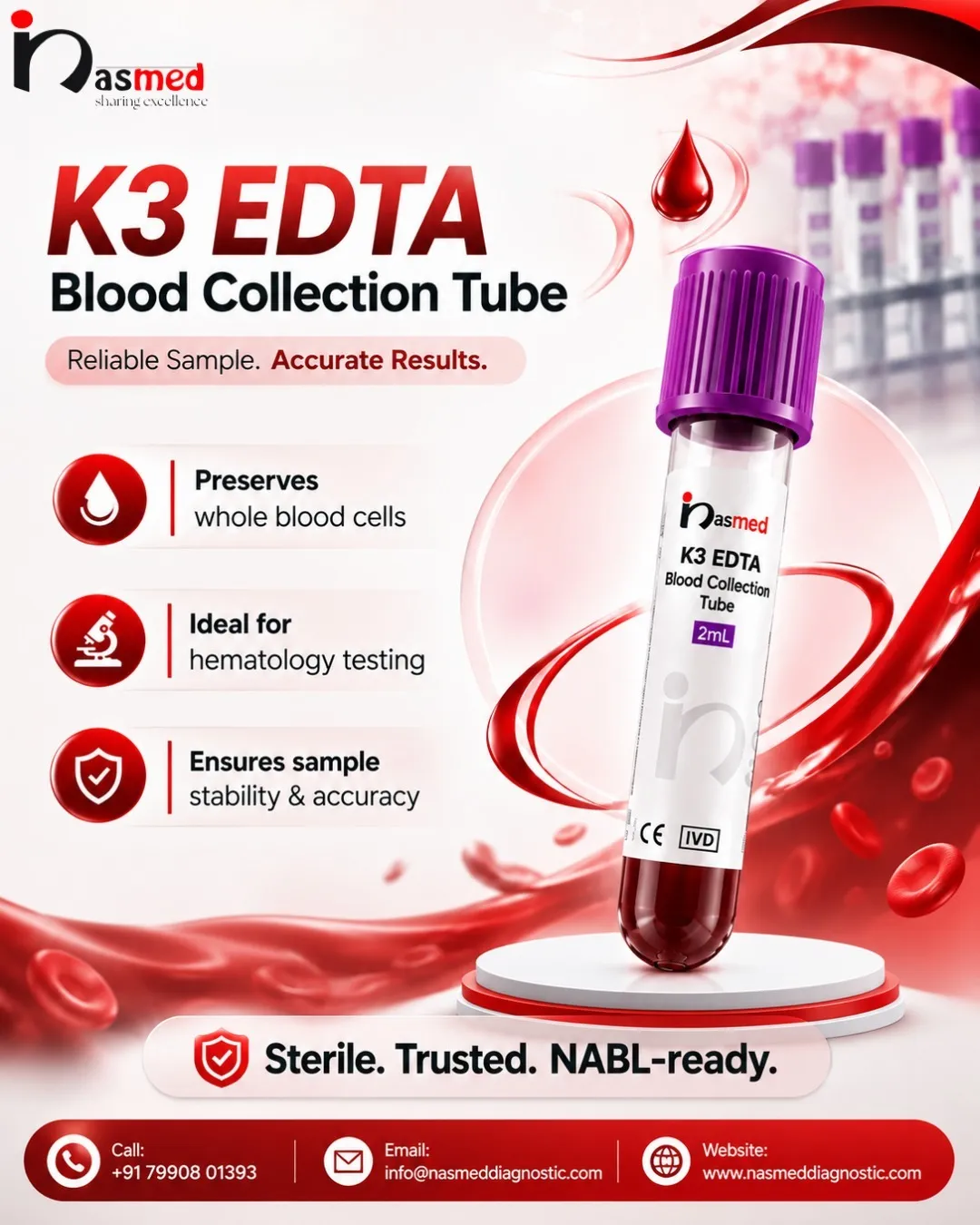
K3 EDTA Tubes: Uses, Benefits & Importance in Accurate Blood Sample Collection
Every reliable blood report starts with a well-collected sample. K3 EDTA tubes keep blood liquid and cells intact, so laboratories can count and examine them accurately. This guide explains what the lavender top tube contains, where labs use it, how K2 vs K3 EDTA differs, and how to choose the right tube for your laboratory.
What Are K3 EDTA Blood Collection Tubes?
K3 EDTA blood collection tubes are specialized laboratory tubes containing K3 EDTA as an anticoagulant. The additive prevents clot formation by binding calcium, which is necessary for the blood coagulation process.
These tubes are commonly used in hematology laboratories to collect and preserve whole blood for cell counting and related investigations.
The tube is generally identified by its lavender or purple-colored cap, although color coding can vary by manufacturer and region. Always check the tube label and manufacturer’s instructions before use.
Key Features of K3 EDTA Tubes
- Additive: Tripotassium EDTA (K3 EDTA).
- Cap color: Commonly lavender or purple.
- Specimen type: Anticoagulated whole blood.
- Primary application: Hematology testing.
- Anticoagulant action: Binds calcium ions to prevent clotting.
- Common tests: CBC, red blood cell count, white blood cell count, platelet count, and hemoglobin estimation.
What Is the Full Form of K3 EDTA?
K3 EDTA stands for tripotassium ethylenediaminetetraacetic acid.
EDTA is a chelating agent that binds calcium ions in blood. Since calcium plays an essential role in the coagulation cascade, removing available calcium prevents the blood from forming a clot.
The potassium salt makes EDTA suitable for use as an anticoagulant in blood collection tubes.
Uses of K3 EDTA Blood Collection Tubes
K3 EDTA tubes are primarily used for hematology investigations that require anticoagulated whole blood.
1. Complete Blood Count (CBC)
A complete blood count measures important blood components, including:
- Red blood cell (RBC) count
- White blood cell (WBC) count
- Platelet count
- Hemoglobin concentration
- Hematocrit
- Red blood cell indices, such as MCV, MCH, and MCHC
CBC testing helps healthcare professionals evaluate a variety of conditions, including anemia, infections, and blood disorders.
2. Hemoglobin Estimation
EDTA-anticoagulated blood can be used to measure hemoglobin concentration using an appropriate laboratory analyzer.
Hemoglobin testing is commonly performed to assess the blood’s oxygen-carrying capacity and support the evaluation of anemia.
3. Differential Leukocyte Count
K3 EDTA blood may be used for white blood cell differential analysis, depending on the laboratory method and validated specimen requirements.
This test measures the proportions or numbers of different white blood cell types.
4. Peripheral Blood Smear
EDTA-anticoagulated blood can be used to prepare peripheral blood smears for microscopic examination.
A blood smear allows laboratory professionals to assess blood cell morphology and identify abnormal cellular features. Smears should be prepared promptly because prolonged storage can cause changes in cell appearance.
5. Other Hematology Investigations
Depending on the laboratory method, K3 EDTA tubes may be suitable for additional tests requiring EDTA-anticoagulated whole blood.
Not every test is compatible with K3 EDTA. The laboratory’s validated procedure and the test manufacturer’s instructions should always determine specimen suitability.
K3 EDTA vs K2 EDTA Blood Collection Tubes
K2 EDTA and K3 EDTA are both potassium salts of EDTA used to prevent blood clotting. Their main difference is the form of the additive and how the tube formulation may affect the specimen.
| Feature | K2 EDTA Tube | K3 EDTA Tube |
|---|---|---|
| Full form | Dipotassium EDTA | Tripotassium EDTA |
| Anticoagulant | K2 EDTA | K3 EDTA |
| Common cap color | Lavender or purple | Lavender or purple |
| Primary application | Hematology | Hematology |
| Formulation | Commonly spray-dried in plastic tubes | Often supplied as a liquid additive, depending on product |
| Potential dilution | Minimal with properly formulated dry additive | Can be greater with liquid additive |
| Common use | Routine CBC and hematology | Routine hematology where validated |
How to Collect Blood in a K3 EDTA Tube
Correct specimen collection is important for obtaining accurate hematology results.
Step 1: Verify the Tube
Check the tube label, additive, expiry date, and integrity before collection. Ensure that the tube is suitable for the requested laboratory test.
Step 2: Collect the Blood Sample
Collect venous blood using an appropriate collection system and the laboratory’s approved procedure.
When using a multi-tube collection system, follow the recommended order of draw to minimize additive carryover.
Step 3: Fill the Tube Correctly
Fill the tube to the manufacturer’s specified volume or fill line.
Underfilling can create an excessive ratio of anticoagulant to blood, potentially affecting cell morphology and test results.
Step 4: Mix the Specimen Gently
Immediately after collection, gently invert the tube according to the manufacturer’s instructions. Many EDTA tubes specify approximately 8–10 inversions, but the exact number depends on the product.
Do not shake the tube vigorously, as this may cause hemolysis or other specimen damage.
Step 5: Label and Transport the Sample
Label the specimen correctly and transport it according to the laboratory’s validated requirements for the requested test.
Avoid unnecessary delays, excessive heat, and other conditions that may compromise specimen quality.
How to Choose the Right Hematology Blood Collection Tubes
Four checks make the decision easier:
- Test menu: Routine CBC, smears, and ESR fit liquid K3. HbA1c and molecular work often favour K2.
- Quality standards: Choose tubes that follow ISO and CLSI guidance for consistent fill volume and additive accuracy.
- Manufacturer credibility: Pick a supplier with documented quality control, certifications, and low breakage rates.
- Format: Select vacuum, non-vacuum, or micro/paediatric tubes based on your collection workflow and patient group.
Why Choose Nasmed Diagnostics?
Nasmed Diagnostics Pvt. Ltd. manufactures premium blood collection tubes from Survey No 282 (Old Block No 213 Paiki), Nandoli, Gandhinagar, Gujarat 382115, India. Directors Kush Patel and Suril Shah lead a highly skilled team of technicians and quality experts. Hospitals, clinics, and laboratories across India trust the company for reliable diagnostic solutions.
- Contamination-free manufacturing: Production takes place in a state-of-the-art ISO 7 clean room facility (Class 10,000).
- CDSCO certified: Regulatory approval supports compliance and patient safety.
- Complete range: Vacuum, non-vacuum, micro/paediatric, cell-free DNA, and gel lithium heparin tubes, plus urine containers and custom diagnostic lab disposables.
- Quality materials: Products follow international material guidelines.
- Affordable pricing and dependable support: Teams get consistent supply and quick answers.
Explore the full range at Nasmed Diagnostics, call +91 79908 01393, message on WhatsApp at +91 74908 06241, or email info@nasmeddiagnostic.com.
Frequently Asked Questions
Q.What is a K3 EDTA tube used for?
- It collects whole blood for hematology tests such as CBC, blood smears, ESR, and blood typing. The tripotassium EDTA additive prevents clotting by binding calcium, so cells stay intact for analysis.
Q.How should I store an EDTA tube?
- Store it at room temperature, away from direct sunlight and moisture. Do not freeze it, and check the expiry date before use.
Q.What is the difference between K2 and K3 EDTA?
- K2 EDTA is spray-dried inside the tube and causes no dilution. K3 EDTA is a liquid and may dilute the sample slightly. Both prevent clotting for hematology.
Q.Why can’t EDTA tubes be used for chemistry or coagulation tests?
- EDTA binds calcium, magnesium, and other metal ions and blocks clotting entirely. This interferes with electrolyte assays and with PT, aPTT, and D-dimer.
Q.What colour is a K3 EDTA tube?
- It usually has a lavender or purple cap. Some manufacturers use a pink cap for the same additive.
Q.How many times should I invert an EDTA tube?
- Invert it gently 8 to 10 times immediately after collection. Proper mixing prevents micro-clots, and shaking can damage cells.
Conclusion
K3 EDTA tubes remain a dependable, low-cost foundation for CBCs, smears, and blood banking. They keep blood fluid, protect cell shape, and give clinicians counts they can trust. Choose the tube that fits your tests and your analyser, train your team on correct handling, follow correct fill and mixing steps, and buy from a certified manufacturer. For clean-room-made, CDSCO-certified collection tubes, contact Nasmed Diagnostics today.
Contact Us