
Faster Emergency Results with Gel Lithium Heparin Plasma Tubes at a 24×7 Trauma Hospital
How a 24x7 trauma hospital cut plasma turnaround time in its emergency lab by skipping the clotting wait.
Case Study Details
A busy multi-speciality trauma and emergency hospital in Hyderabad, with a 24x7 casualty, ICU and operation theatres, wanted its emergency laboratory to deliver critical chemistry results faster. This case study explains how switching the STAT chemistry workflow to Nasmed's Gel Lithium Heparin blood collection tubes reduced turnaround time and repeat sampling.
BACKGROUND In an emergency department, minutes matter. Patients arriving after road accidents, cardiac events, sepsis, stroke or severe dehydration need quick results for electrolytes (sodium, potassium), kidney function (urea, creatinine), blood glucose, liver enzymes and cardiac markers. The hospital's emergency lab handled samples round the clock, with the heaviest load at night and during peak casualty hours.
THE CHALLENGE
- Clotting wait: the lab used serum tubes for STAT chemistry. Blood must clot fully before centrifugation, which usually takes around 20 to 30 minutes. In an emergency, that wait directly delayed treatment decisions.
- Incomplete clotting: samples from patients on anticoagulant therapy, or with very high or low blood counts, often clotted slowly. Fibrin strands and micro-clots then formed in the serum and caused analyser probe blockages and repeat testing.
- Poor barrier separation: some gel batches used earlier did not form a clean, stable barrier, leading to cell contamination and falsely high potassium and glucose changes if samples sat before analysis.
- Night-shift pressure: with fewer staff at night, every repeat sample added workload and delayed other patients.
- Supply uncertainty: emergency labs cannot afford a stock-out, and the hospital had faced occasional delays from its earlier supplier.
THE SOLUTION Nasmed proposed shifting routine STAT chemistry to Gel Lithium Heparin plasma tubes, supported by a small set of complementary tubes:
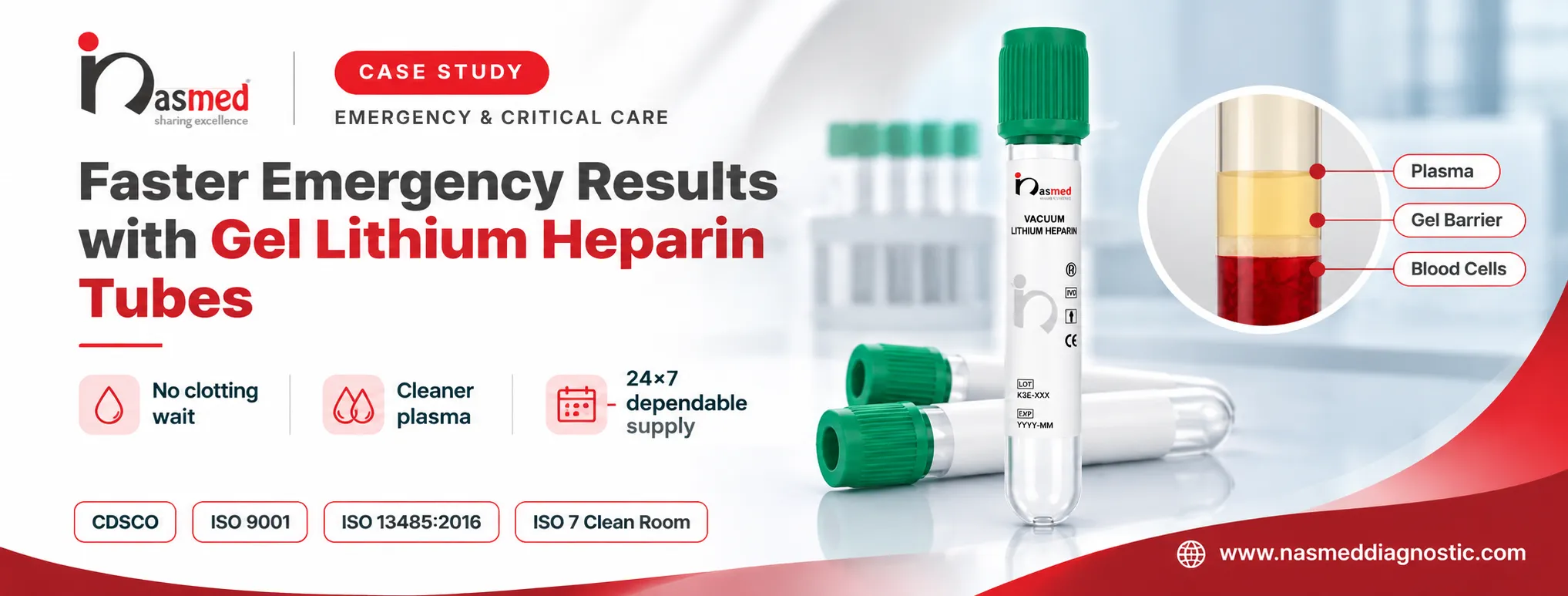
- Gel Lithium Heparin tubes for emergency plasma chemistry. Heparin prevents clotting, so the tube can be centrifuged soon after collection, and the gel forms a barrier between plasma and cells.
- Lithium Heparin tubes (without gel) for specific workflows where the lab wanted plasma without a gel barrier.
- Sodium Heparin tubes for blood gas analysis in the ICU.
- Sodium Fluoride tubes for blood glucose where delayed processing was expected.
- Gel + Clot Activator tubes for tests where serum is still required, for example certain immunoassays. All tubes are made in Nasmed’s ISO 7 clean room facility in Gandhinagar, Gujarat. Nasmed is a CDSCO-certified manufacturer with ISO 9001, ISO 13485:2016, CE and GMP credentials.
HOW WE IMPLEMENTED?
- IT Phase 1, Workflow study: our technical team mapped the full STAT workflow in the emergency lab, from sample collection at the bedside to result release, and measured where time was lost.
- Phase 2, Test menu validation: the lab’s pathologist selected the STAT tests suitable for plasma, such as electrolytes, urea, creatinine, glucose, liver enzymes and common cardiac markers, and ran parallel testing of serum versus Nasmed lithium heparin plasma samples on the hospital’s own analyser. Results were compared against the lab’s internal acceptance limits. Tests where the manufacturer’s assay recommends serum only were kept on serum tubes.
- Phase 3, Staff training: emergency nurses and phlebotomists were trained on correct draw order (blood culture, citrate, serum tubes, then heparin, then EDTA, then fluoride), complete filling of the tube, and gentle inversion of heparin tubes 8 to 10 times to mix the additive.
- Phase 4, Pilot: a two-week pilot ran in the casualty and ICU, with daily feedback from the night-shift supervisor.
- Phase 5, Rollout and stock plan: after the pilot, the tube was adopted for all STAT chemistry. A buffer stock plan with weekly dispatch and an emergency top-up arrangement was agreed so the lab never ran short.
QUALITY ASSURANCE BEHIND THE PRODUCT
- Controlled heparin dosing for consistent anticoagulation in every tube
- Gel barrier formed to remain stable through centrifugation and short storage
- Manufacturing in an ISO 7 controlled environment with air quality and particulate monitoring
- Batch-wise inspection of vacuum, additive, cap fit and labels, with full batch traceability
- Lithium heparin tubes are not used for lithium level testing, a point clearly communicated to the hospital’s lab staff
RESULTS
- STAT chemistry turnaround time reduced by around 25 minutes on average, because the lab no longer waited for blood to clot
- Repeat samples caused by incomplete clotting and fibrin interference fell by around 45 percent
- Analyser probe blockages and downtime reduced
- Cleaner, stable plasma separation across night-shift batches
- Emergency clinicians received critical electrolyte and kidney results sooner, supporting faster treatment decisions
- Supply remained uninterrupted through the review period, including festival and peak-demand weeks
WHY IT MATTERS?
In emergency medicine, laboratory speed is part of patient care. Removing a clotting wait that adds nothing to the test result gives clinicians their numbers sooner. The right tube choice, validated by the hospital’s own pathologist, makes that gain safe and reliable.
KEY LEARNINGS
- Plasma tubes can remove the clotting wait for STAT chemistry, but each assay must be validated on the lab’s own analyser.
- Training on draw order and inversion is as important as the tube chemistry.
- A mixed tube strategy, plasma where suitable and serum where required, gives the best result.
- Emergency labs need a supplier with buffer stock and flexible dispatch.
FREQUENTLY ASKED QUESTIONS
Q1. Why is plasma faster than serum for emergency testing?
- Serum needs blood to clot, which usually takes 20 to 30 minutes. In a heparin tube, the anticoagulant prevents clotting, so the sample can be centrifuged soon after collection and plasma is ready for the analyser sooner.
Q2. What does the gel do in a Gel Lithium Heparin tube?
- After centrifugation, the gel forms a barrier between the plasma and the blood cells. This helps keep the plasma clean and stable until analysis and reduces cell contamination.
Q3. Can all tests be run on lithium heparin plasma?
- No. Many routine chemistry and emergency tests are suitable, but some assays require serum or a different additive. Always check the analyser and reagent instructions and validate on your own system. Lithium heparin tubes should not be used for lithium level testing.
Q4. Which tube is used for blood gas analysis?
- Sodium Heparin tubes are commonly used for blood gas analysis. Nasmed offers Sodium Heparin tubes for clinical plasma determinations and blood gas workflows.
Q5. Is Nasmed’s Gel Lithium Heparin tube certified?
- Yes. Nasmed Diagnostics is a CDSCO-certified manufacturer with ISO 9001, ISO 13485:2016, CE and GMP credentials. Tubes are produced in an ISO 7 clean room in Gandhinagar, Gujarat.
Q6. How can a hospital get a supply plan for its emergency lab?
- Contact info@nasmeddiagnostic.com or WhatsApp +91 74908 06241 for samples, specifications and a scheduled supply plan with buffer stock.