
Lithium Heparin vs EDTA Tube: Key Differences, Uses, Tests and Handling Guide for Labs
Lithium heparin vs EDTA tube is one of the most common questions in a collection room, and the answer decides whether a sample can be used at all. Both are anticoagulant tubes that stop blood from clotting, but they work in different ways and suit very different tests. Using the wrong one can distort potassium results, spoil a blood count or force a recollection. This guide compares the two side by side so your team can choose correctly every time.
Short answer: Use lithium heparin (green closure) for plasma chemistry and STAT work. Use EDTA (lavender, pearl or pink closure) for blood counts, haematology and blood bank testing. Do not swap them.
How a Green Top Tube Works
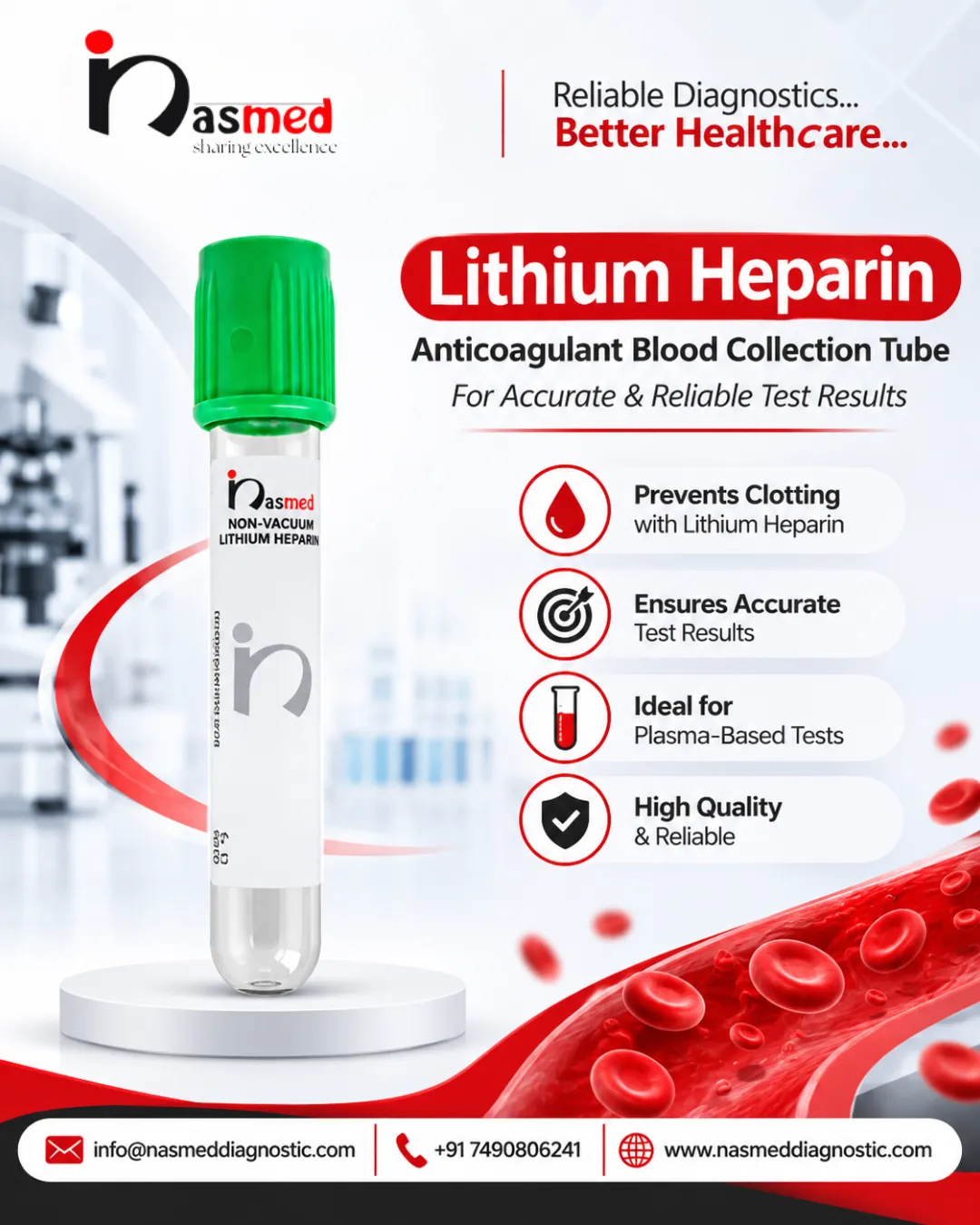
This tube contains heparin, which activates antithrombin and blocks the clotting cascade. The blood stays liquid and can be centrifuged straight away to give plasma, with no wait for a clot. In most lithium heparin tubes the additive is spray-dried on the inner wall so it dissolves evenly as blood enters. Gel versions add a separator that forms a barrier between cells and plasma.
For general chemistry, lithium heparin is usually preferred over sodium heparin, because BD notes that sodium results run about 1 to 2 mmol/L higher in properly filled sodium heparin tubes.
How a Lavender Top Tube Works
EDTA binds calcium, which blood needs in order to clot. With calcium removed, the sample stays unclotted and the cells keep their shape, which is why EDTA is the standard additive for haematology. Lavender is the common choice, while pearl and pink closures are used for gel and blood bank versions.
A hospital collection guide lists typical EDTA tests such as the complete blood count, differential, HbA1c and ESR in purple tubes, and blood typing, antibody screening and HIV-1 RNA quantification in pink tubes.
Lithium Heparin vs EDTA Tube: Key Differences
| Feature | Lithium heparin | EDTA |
|---|---|---|
| Closure colour | Green | Lavender, pearl, pink |
| How it works | Activates antithrombin, blocks the clotting cascade | Binds calcium |
| Best for | Chemistry, electrolytes, enzymes, STAT tests | Blood counts, HbA1c, ESR, blood bank |
| Avoid for | Lithium levels, PCR and RNA work, coagulation | Potassium, calcium, magnesium, coagulation |
| CLSI draw position | 4 | 5 |
Neither tube is suitable for PT or aPTT. Those tests need a sodium citrate tube.
Contact UsWhen to Choose a Lithium Heparin vs EDTA Tube
Choose lithium heparin when you need:
- Electrolytes such as sodium, potassium and chloride
- Liver and kidney function tests
- Glucose, calcium and enzyme assays
- Blood gas and other rapid chemistry results
Choose EDTA when you need:
- A complete blood count with differential
- HbA1c or ESR
- Blood grouping and antibody screening
- Molecular tests where heparin could interfere. One RNA study found that lithium heparin strongly inhibited reverse transcriptase and DNA polymerase.
If your test menu spans both groups, collect separate tubes. Never split one tube between departments.
EDTA Contamination: Why Mix-Ups Matter
EDTA contamination is a well-known cause of misleading chemistry. Published work on this problem shows that it raises plasma potassium and lowers calcium and magnesium, so a normal patient can appear dangerously hyperkalaemic.
The problem is not always obvious. In a one-month UK study, 28 of 117 samples with potassium of 6.0 mmol/L or above were contaminated, and ten were reported before anyone recognised it. Repeat samples were normal in 27 of the 28 cases where a repeat was taken.
The most common causes are a wrong draw sequence, pouring blood between tubes and backflow from a syringe. Each of these is easy to prevent with good habits.
Handling Tips for Both Tubes
- Follow the CLSI draw sequence. CLSI places heparin before EDTA, so the green top tube comes before the lavender top tube.
- Fill to the line. Underfilled tubes upset the blood-to-additive ratio.
- Mix straight away. Gently invert 8 to 10 times to avoid microclots.
- Centrifuge heparin plasma promptly. BD guidance is up to 1300 g for 10 minutes at 18 to 25 °C.
- Never pour between tubes. Transfer devices and the correct sequence prevent EDTA contamination.
- Label at the bedside. Record collection time and tube type.
Choosing Quality Anticoagulant Tubes
Good technique needs well-made tubes. When buying, look for:
- Evenly applied additive with consistent dosing
- Accurate vacuum and draw volume
- Secure, leak-free closures
- Clear colour coding that follows standard practice
- Sterile packing with batch traceability
- Compliance with international material guidelines
Cleanroom manufacturing also helps, as it reduces particles and contamination in tubes that must stay chemically precise.
About Nasmed Diagnostics Pvt. Ltd.
Nasmed Diagnostics Pvt. Ltd. (Nasmed Diagnostics) is a Gandhinagar-based manufacturer of diagnostic lab disposables. The company is led by Directors Kush Patel and Suril Shah, with a highly skilled team of technicians and quality experts working in a state-of-the-art ISO 7 cleanroom facility (Class 10,000). It is CDSCO certified and trusted by hospitals, clinics and labs across India.
Its range includes Vacuum, Non-Vacuum, Micro/Paediatric, Cell-Free DNA and Gel Lithium Heparin tubes, plus urine containers and custom diagnostic lab disposables.
Address: Survey No. 282 (Old Block No 213 Paiki), Nandoli, Gandhinagar, Gujarat 382115, India.
Why Choose Nasmed Diagnostics?
- Contamination-free manufacturing in an ISO 7 cleanroom
- CDSCO certified products
- Premium anticoagulant tubes and a wide collection range
- International material guidelines followed in production
- Affordable pricing without compromising accuracy
- Reliable support and accurate sample handling solutions
- Custom diagnostic lab disposables made to your requirements
Contact: +91 79908 01393 | WhatsApp: +91 74908 06241 | info@nasmeddiagnostic.com
Frequently Asked Questions
What is the difference between a lithium heparin vs EDTA tube?
- Lithium heparin blocks clotting through antithrombin and gives plasma for chemistry. EDTA binds calcium and preserves cells for blood counts and haematology. They are not interchangeable.
Can an EDTA tube be used for chemistry tests?
- Not for routine chemistry. EDTA raises potassium and lowers calcium and magnesium, so results would be unreliable. Use a lithium heparin or serum tube instead.
Which is drawn first, heparin or EDTA?
- Heparin comes first. In the CLSI sequence, the green top tube is drawn before the lavender top tube.
What colour is an EDTA tube?
- EDTA tubes have lavender, pearl or pink closures. A lavender top tube is the most common for blood counts.
What does EDTA contamination do to results?
- It falsely raises potassium and lowers calcium and magnesium. A repeat sample collected in the correct order usually gives normal values.
Can a green top tube be used for a CBC?
- A complete blood count is normally run on EDTA, so use a lavender tube. Check your analyser’s requirements before using any other tube.
How many times should these tubes be inverted?
- Gently invert 8 to 10 times straight after collection to mix the additive and prevent microclots.
Who makes quality anticoagulant tubes in India?
- Nasmed Diagnostics Pvt. Ltd. in Gandhinagar, Gujarat manufactures CDSCO-certified tubes in an ISO 7 cleanroom. Call +91 79908 01393.
Conclusion
The lithium heparin vs EDTA tube decision comes down to the test: green for plasma chemistry, lavender for blood counts and haematology. Follow the correct draw sequence, mix every tube properly and prevent carryover errors with good technique. Pair that with dependable tubes from a trusted manufacturer. To discuss your lab’s needs, contact Nasmed Diagnostics Pvt. Ltd. on +91 79908 01393, WhatsApp +91 74908 06241 or info@nasmeddiagnostic.com.
Contact Us