
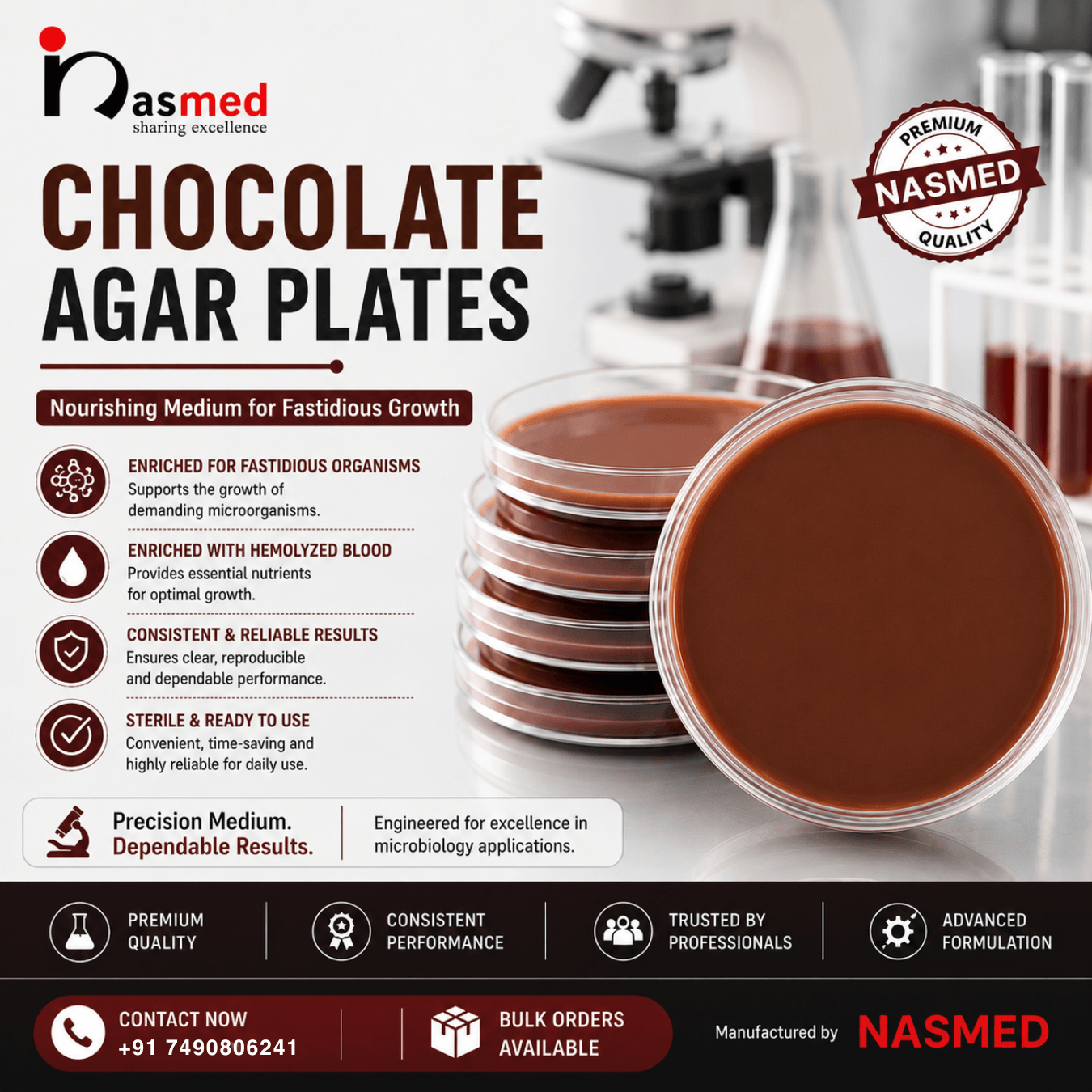
Chocolate Agar Plates: Uses, Composition, Incubation and How to Choose Ready-to-Use Plates
Chocolate agar plates are an enriched, non-selective culture medium used to grow fastidious bacteria such as Haemophilus influenzae and Neisseria gonorrhoeae. The medium is brown because heated blood releases the growth factors these organisms need; it contains no chocolate. This guide explains how chocolate agar works, which organisms and specimens it is used for, how to incubate and read the plates, and what Indian diagnostic laboratories should check when choosing ready-to-use (RTU) chocolate agar plates.
Quick Facts: Chocolate Agar at a Glance
- Type: enriched, non-selective medium
- Key growth factors: hemin (X factor) and NAD (V factor)
- Typical incubation: 35 to 37 °C, 5 to 10% CO2, 24 to 48 hours
- Main organisms: H. influenzae, N. gonorrhoeae, N. meningitidis, Streptococcus pneumoniae
What Are Chocolate Agar Plates?
Chocolate agar is a variant of blood agar. In the usual preparation, red blood cells are heated (about 80 °C) so they burst and release their contents into the agar. The heated blood turns the medium a chocolate-brown colour, which gives the plate its name. Because it is rich in nutrients, it supports organisms that will not grow on ordinary nutrient agar or that grow poorly on blood agar.
How Chocolate Agar Works: X and V Factors Explained
Red blood cells contain hemin (X factor) and NAD (V factor). Haemophilus influenzae needs both. On standard blood agar, NAD is largely unavailable and enzymes in intact cells can break it down, so H. influenzae usually grows only as small satellite colonies around a bacterium that releases NAD, such as Staphylococcus aureus. Heating the blood lyses the cells and inactivates those enzymes, so X and V factors are freely available across the whole plate.
Chocolate Agar vs Blood Agar
| Feature | Chocolate agar | Blood agar |
|---|---|---|
| Blood treatment | Heated, cells lysed | Fresh blood added, cells intact |
| Appearance | Opaque chocolate brown | Red |
| X and V factors | Freely available | V factor limited |
| H. influenzae | Grows across the plate | Grows as satellite colonies near S. aureus |
| Haemolysis reactions | Cannot be read | Can be read (alpha, beta, gamma) |
| Typical role | Isolating fastidious organisms | General purpose, haemolysis patterns |
Organisms That Grow on Chocolate Agar
Chocolate agar is used for Haemophilus species and pathogenic Neisseria, and it also supports common respiratory pathogens such as Streptococcus pneumoniae. Many of these organisms are capnophilic, meaning they grow better in raised CO2.
| Organism | Typical specimen | Notes |
|---|---|---|
| Haemophilus influenzae | Respiratory, CSF, eye | Requires X and V factors; grows on chocolate agar but not on plain nutrient agar |
| Neisseria gonorrhoeae | Genital, eye | Fastidious; often cultured on selective chocolate-based media from non-sterile sites |
| Neisseria meningitidis | CSF, blood | Grows in CO2 on chocolate agar |
| Streptococcus pneumoniae | Respiratory, CSF | Also grows on blood agar |
Final identification always depends on Gram stain, biochemical or molecular confirmation and your laboratory’s own protocols, not on colony appearance alone.
Uses of Chocolate Agar Plates in Diagnostic Laboratories
Laboratories use chocolate agar to isolate fastidious organisms from specimens such as CSF, respiratory samples, genital swabs and eye specimens. Modified forms add selective agents:
- Bacitracin chocolate agar: favours Haemophilus by suppressing many other organisms.
- Thayer-Martin agar: chocolate-based medium with antibiotics that favours pathogenic Neisseria from non-sterile sites.
How to Incubate and Read Chocolate Agar Plates
- Bring plates to room temperature and check they are not cracked, dry or contaminated.
- Inoculate with the specimen and streak for isolation.
- Incubate at 35 to 37 °C in 5 to 10% CO2 (a CO2 incubator, or a candle jar if no incubator is available).
- Read at 24 hours and again at 48 hours; extend incubation for CSF cultures per your laboratory protocol.
- Identify suspect colonies with Gram stain and confirmatory tests, then subculture as needed.
Ready-to-Use (RTU) Chocolate Agar Plates from Nasmed
Nasmed Diagnostic Pvt. Ltd. is a CDSCO-certified manufacturer of blood collection tubes and laboratory consumables, based in Gandhinagar, Gujarat, with an ISO 7 clean-room facility. Our pre-poured chocolate agar plates are supplied to diagnostic laboratories, hospitals and clinics across India, including Gujarat, Maharashtra and Rajasthan.
What to Check on the Product Specification
Whichever supplier you use, ask for the specification sheet and confirm these points before ordering:
- Plate diameter and fill volume
- Base medium and the blood or haemoglobin supplement used
- Pack size and how the plates are packed for transport
- Storage temperature and shelf life printed on the label
- Final pH and appearance (uniform chocolate-brown, no drying or cracks)
- Sterility and growth-performance testing before release
Quality Control Expected from RTU Plates
Good practice for ready-to-use chocolate agar is that each batch is checked for sterility and tested for growth with reference strains such as Haemophilus influenzae and Neisseria gonorrhoeae before release, with batch records kept for traceability. Contact Nasmed for the specification sheet and batch documentation for the plates you plan to order.
Request a quote or view our agar plates range.
How to Choose a Chocolate Agar Plate Supplier in India: Checklist
- Batch QC records and certificate of analysis available on request
- Remaining shelf life on delivery
- Cold-chain or temperature-controlled transport
- Consistent colour, fill volume and surface moisture between batches
- Sterility testing before release
- Manufacturer’s regulatory status and traceability
- Technical support and re-supply lead times for your city
Limitations of Chocolate Agar
- It is non-selective, so contaminating bacteria can overgrow slow-growing pathogens when specimens come from non-sterile sites.
- Haemolysis patterns cannot be read because the blood is lysed.
- Plates can dry out or lose quality if stored incorrectly or kept past expiry.
- Colony appearance alone does not identify an organism; confirmatory testing is required.
Frequently Asked Questions
Why is it called chocolate agar?
- The name comes from the brown colour of the medium, which results from heating blood. It does not contain chocolate.
What is the difference between chocolate agar and blood agar?
- Chocolate agar uses heated, lysed blood, which makes X and V factors available so Haemophilus grows across the plate. Blood agar uses intact cells and is used mainly to read haemolysis patterns.
What organisms grow on chocolate agar?
- Fastidious organisms including Haemophilus influenzae, Neisseria gonorrhoeae, Neisseria meningitidis and Streptococcus pneumoniae.
How should chocolate agar plates be incubated?
- Typically at 35 to 37 °C in 5 to 10% CO2 for 24 to 48 hours, with longer incubation for some specimens such as CSF.
What are ready-to-use (RTU) chocolate agar plates?
- RTU plates are supplied pre-poured and quality checked, so the laboratory does not have to prepare the medium in-house.
How should RTU plates be stored?
- Chocolate agar plates are generally stored refrigerated at 2 to 8 °C and used before the expiry date. Always follow the storage instructions and expiry date printed on the product label, and let plates reach room temperature before inoculation.
References
- Tille PM. Bailey and Scott’s Diagnostic Microbiology, 15th ed. (2022).
- Procop GW et al. Koneman’s Color Atlas and Textbook of Diagnostic Microbiology, 7th ed. (2017).
- Mahon CR, Lehman DC. Textbook of Diagnostic Microbiology, 6th ed. (2018).
- Chocolate agar, Wikipedia